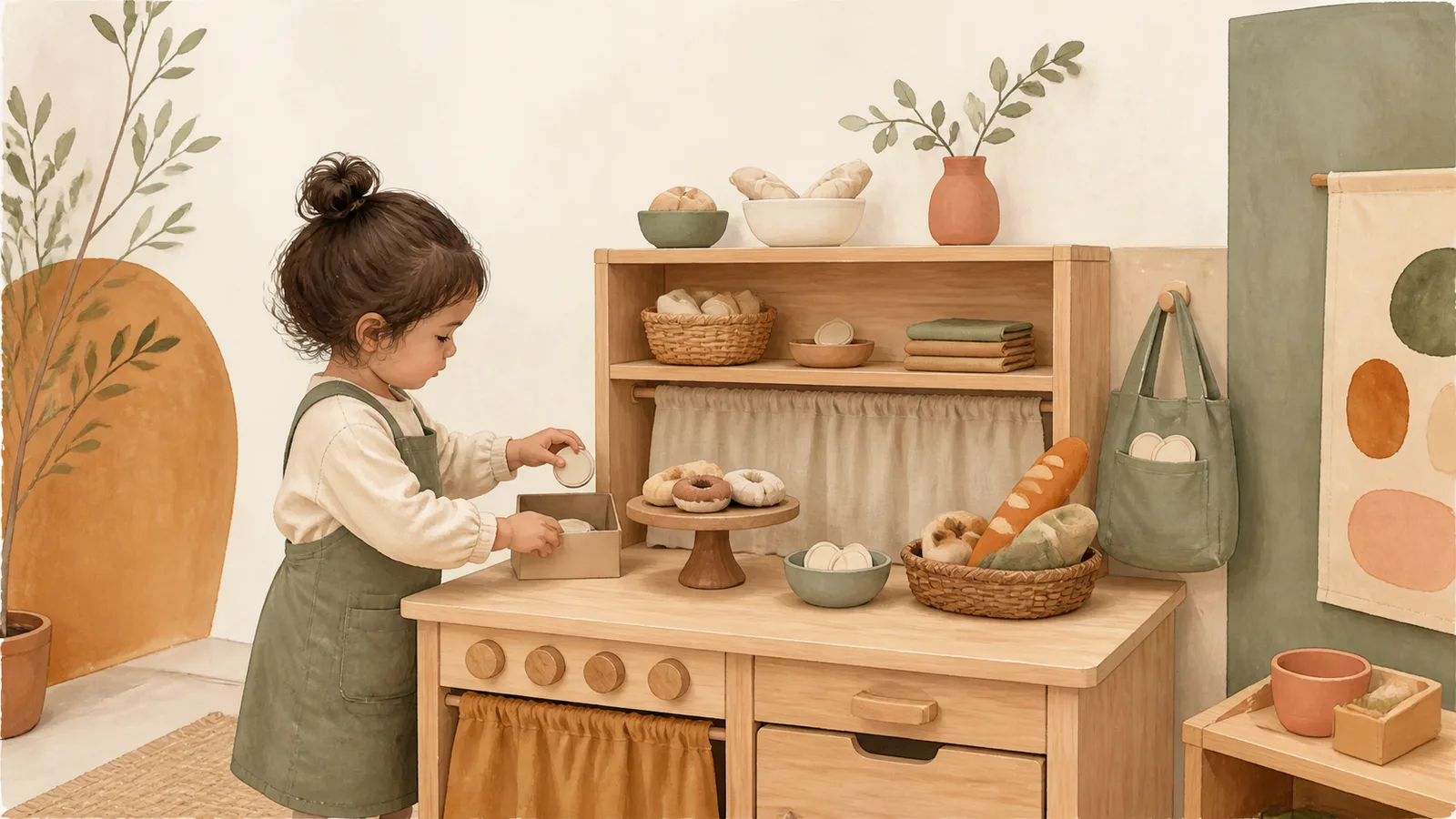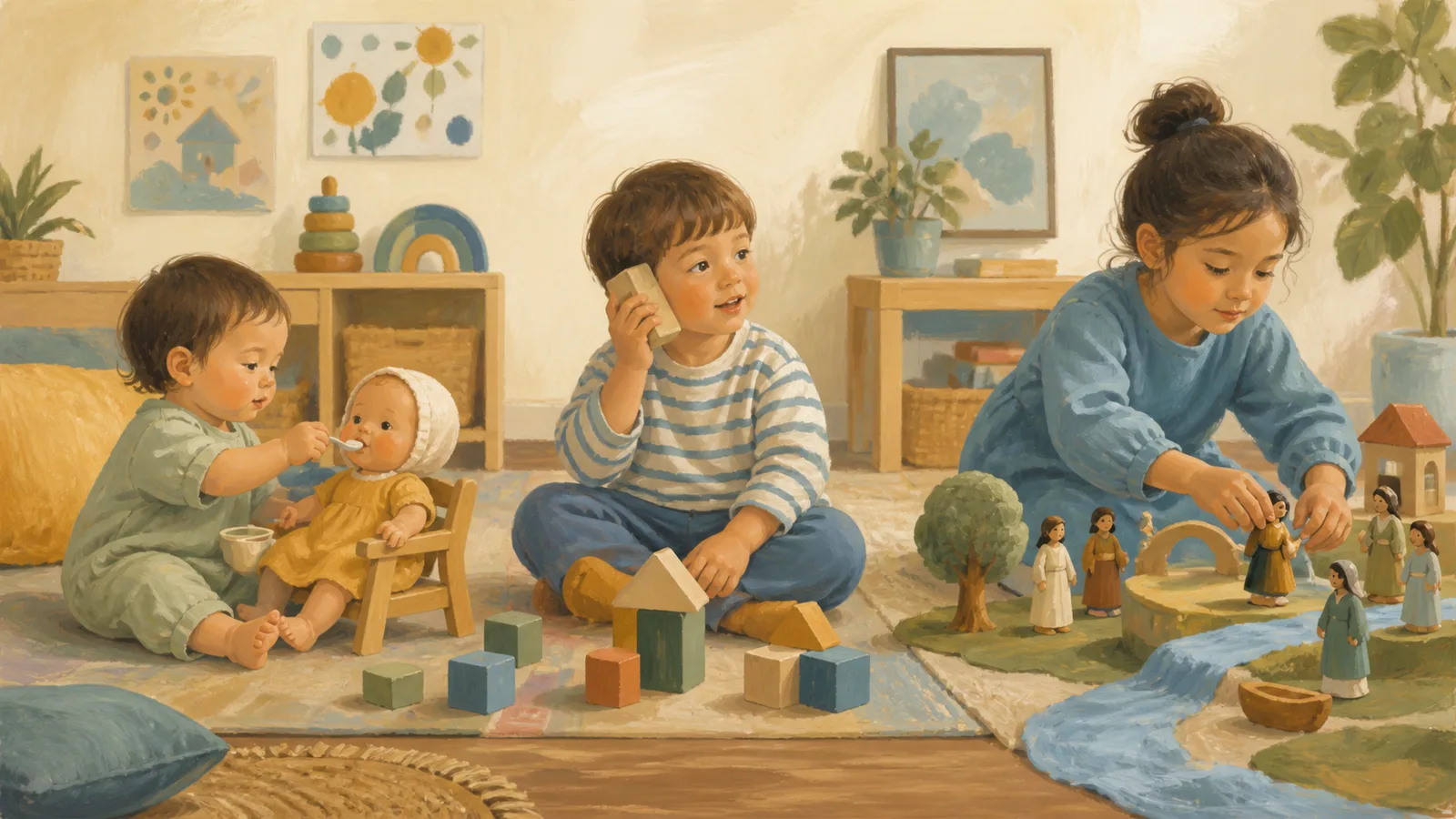
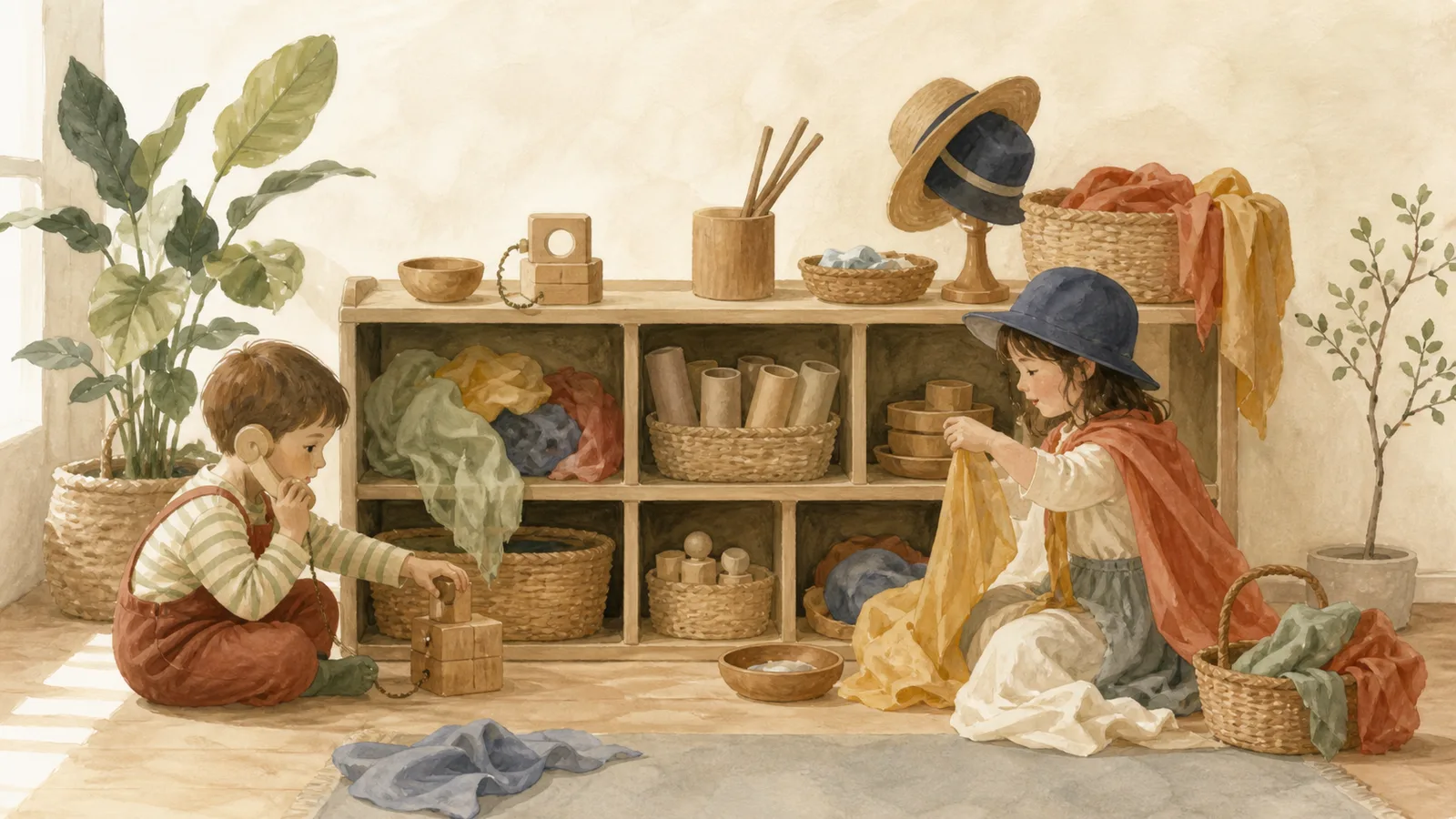
A useful pretend-play prop does more than look convincing. It gives a child an action: carry, wrap, call, serve, repair, hide, deliver, or become someone new. The best small collection combines a few recognizable objects with materials that can change identity.
You do not need a different kit for doctor, shop, astronaut, café, and rescue play. Start with five jobs.
Build around five prop functions
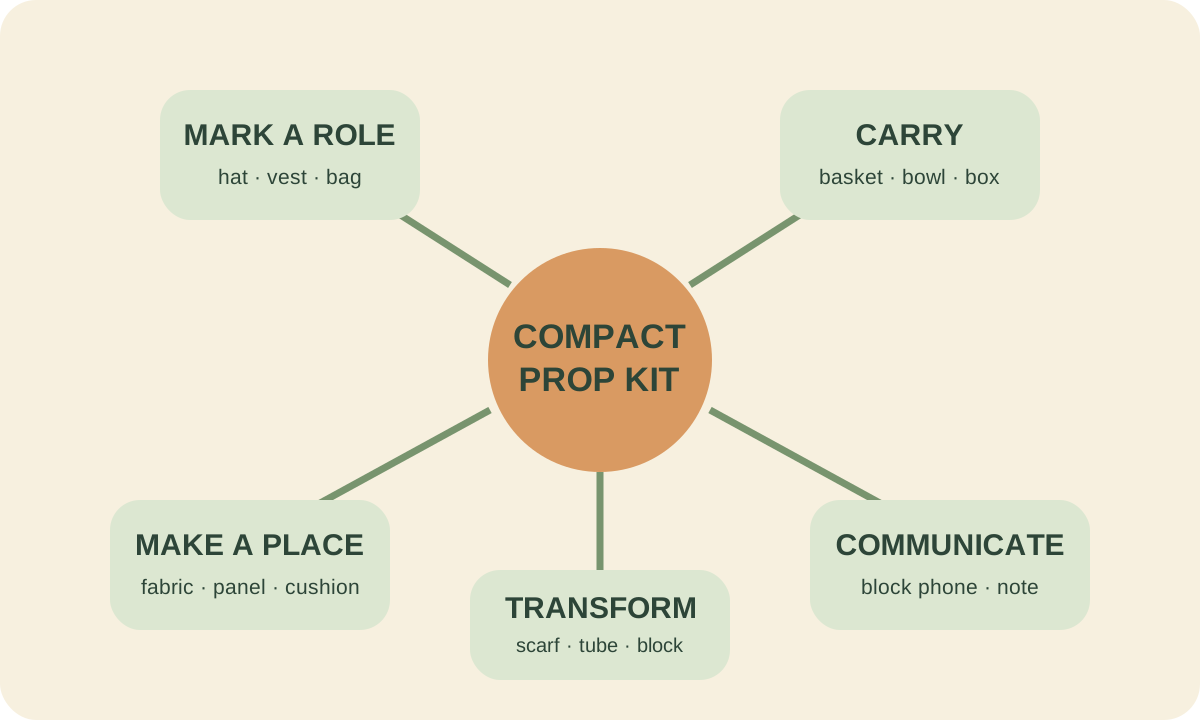
| Function | Useful examples | What it can become |
|---|---|---|
| Mark a role | plain hat, fabric vest, tote, wristband | driver, keeper, explorer, cook |
| Carry or contain | basket, small bag, bowl, sturdy box | delivery bag, pet bed, mixing bowl, treasure chest |
| Define a place | fabric square, cushions, cardboard panel | river, roof, counter, campsite |
| Communicate | block phone, clipboard, envelopes, safe toy radio | booking desk, control room, post office |
| Transform | scarves, tubes, blocks, clips suitable for age | cape, bandage, telescope, food, tools |
This framework makes buying decisions easier. If three new objects perform the same narrow role, they add volume more than possibility.
Realistic and abstract props are partners
A realistic toy cup immediately suggests drinking. That can help a child reproduce a familiar routine. A plain wooden disk demands more symbolic work but might be a cookie, coin, wheel, plate, or moon.
Neither type is inherently better. Children new to a story may benefit from one clear cue—a hat for a firefighter or bowl for a kitchen. Once the action starts, flexible materials let the plot travel. Pair rather than polarize them: one recognizable medical bag with fabric strips and animal patients; one basket with blocks that become groceries, parcels, or ingredients.
Our guide to the stages of pretend play explains why object substitution is only one dimension of development, not a test a child must pass.
A practical starter collection
For a child past the mouthing stage, a compact shelf might hold:
- three fabric pieces in different sizes;
- two baskets or handled containers;
- a set of plain blocks or large disks;
- one or two hats without long cords;
- several sheets of scrap paper and chunky drawing tools;
- clean, sturdy food containers with lids removed if they trap fingers;
- two stuffed animals or dolls; and
- a short cardboard tube, only if it remains intact and age appropriate.
Add household objects slowly. A real item is not automatically a safe toy. Remove plastic bags, batteries, medicines, sharp tools, breakable containers, long cords, magnets, and anything small enough to be swallowed. When younger siblings share the room, the accessible collection must be safe for the youngest child who can reach it. See our broader household-object safety checks before opening a kitchen drawer as a prop source.
Store for use, not display
Deep dress-up bins make children excavate everything to find one hat. Hang two role markers at child height, fold fabrics in a shallow basket, and keep containers nested. Put paper accessories in a flat tray.
Rotate only the most specific items. A veterinary bag can leave for a few weeks; the scarves and baskets can stay because they support many plots. If a child repeatedly asks for one stored prop, that item has earned a regular place.
In a very small home, use one lidded basket and a folded fabric square as the “set.” The basket becomes storage after play and furniture during it. A play kitchen is optional; a low stool can be a counter, stove, clinic desk, or ticket booth.
Help a story begin, then leave it
When a child asks, “What should I play?” offer a problem rather than a script:
- “This package has no address. Who could help?”
- “The animal will not fit through that doorway.”
- “The café has bowls but no table.”
- “The expedition needs a way to carry water.”
Join long enough to establish an action. Then give your role a natural exit: “I’ve delivered the parcel; I’m going back to the depot.” If the child wants continued company, set an honest boundary—“I can be the customer for five minutes”—rather than quietly taking control or promising indefinite play.
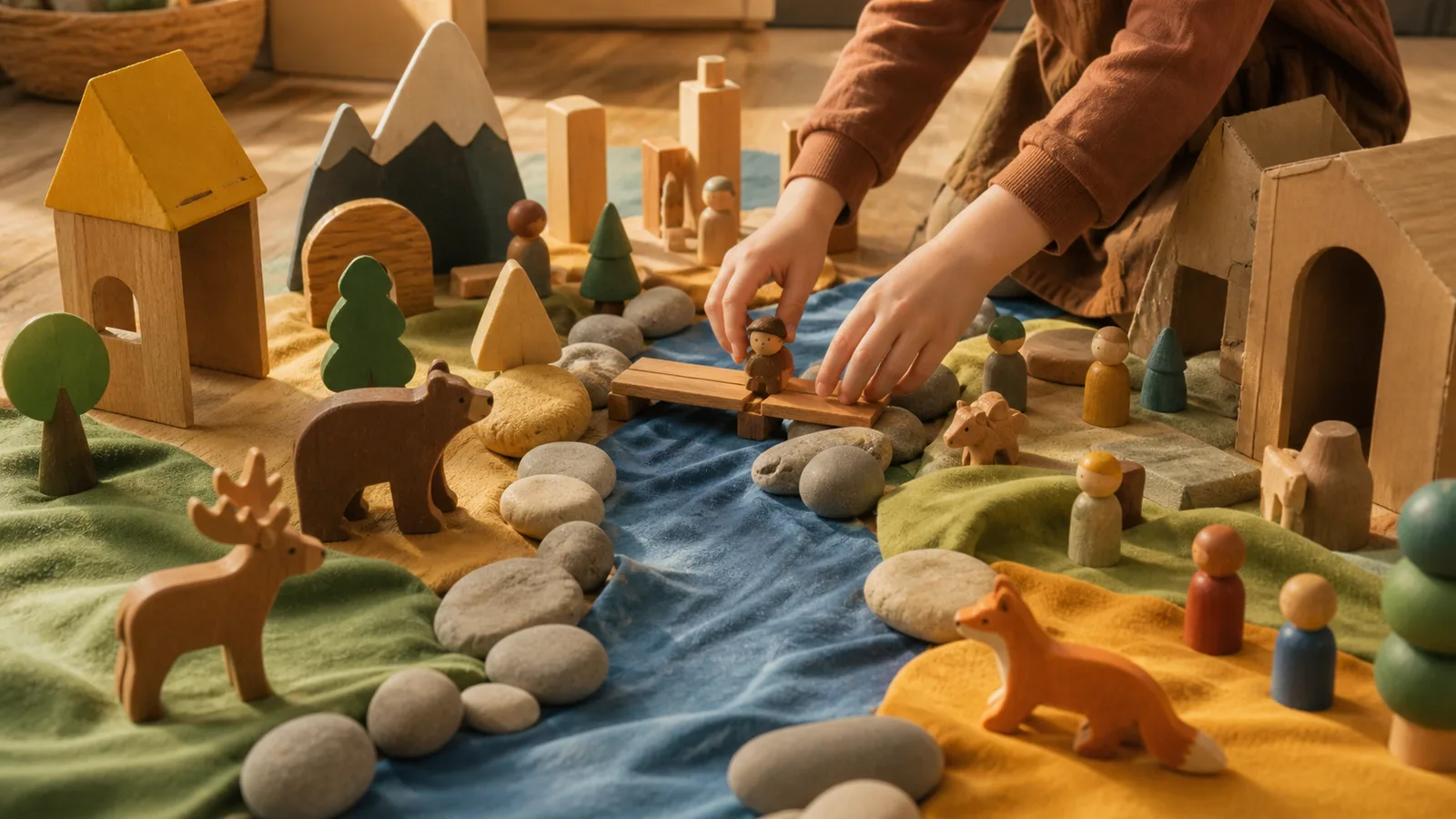
Children who prefer figures to costumes may engage more readily with a changeable small-world setup. A child who repeats one familiar scene is still pretending; novelty is not a requirement.
Mixed ages and different play styles
Give siblings parallel responsibilities instead of one desirable lead role. A younger child can carry parcels while an older child maps routes, sets prices, or creates a dispatch problem. Keep older children’s small writing tools and miniature pieces outside a younger child’s reach.
Some children enjoy reenacting exact routines. Others make rapid substitutions, narrate privately, arrange scenes without voicing characters, or prefer to watch. Do not demand eye contact, costumes, dialogue, or public performance as proof of imagination. Offer materials that fit the child’s motor, sensory, language, and communication preferences.
What the research can—and cannot—say
Pretend play creates a context for symbolic action, conversation, negotiation, and shared attention. Studies find relationships between pretend play and outcomes such as language or social competence. That does not establish that buying props causes those outcomes. A major evidence review concluded that many popular causal claims were not supported, and a recent social-competence meta-analysis still called for research on direction of causality.
The practical case is simpler: props can help children enter and sustain stories they value. Choose them for usable actions, not promises printed on packaging.
Frequently asked questions
How many pretend-play props does a child need?
There is no evidence-based number. Begin with enough to cover the five functions above and add an item only when it solves a recurring play need.
Are play silks necessary?
No. Hemmed fabric remnants, old pillowcases, and lightweight scarves can perform similar jobs if they are clean, intact, and free of unsafe cords or embellishments.
What if my child only uses an object one way?
That is fine. Familiar functional actions often support later pretense, and not every child enjoys object substitution. Demonstrate one alternative once, then let the child decide.
Should costumes be realistic?
One recognizable role cue can help. Complete character costumes are less flexible and quickly outgrown, so combine a few specific pieces with adjustable, non-character materials.
Sources and research note
This guide draws on the peer-reviewed review The Impact of Pretend Play on Children’s Development, a review of pretend-play definition and developmental progression, a recent meta-analysis of pretend play and social competence, and a meta-analysis of symbolic play and language. Practical context comes from Penn State Extension, the AAP’s family pretend-play guidance, and the CPSC toy safety center. LWT did not hands-on test or rank commercial prop sets.