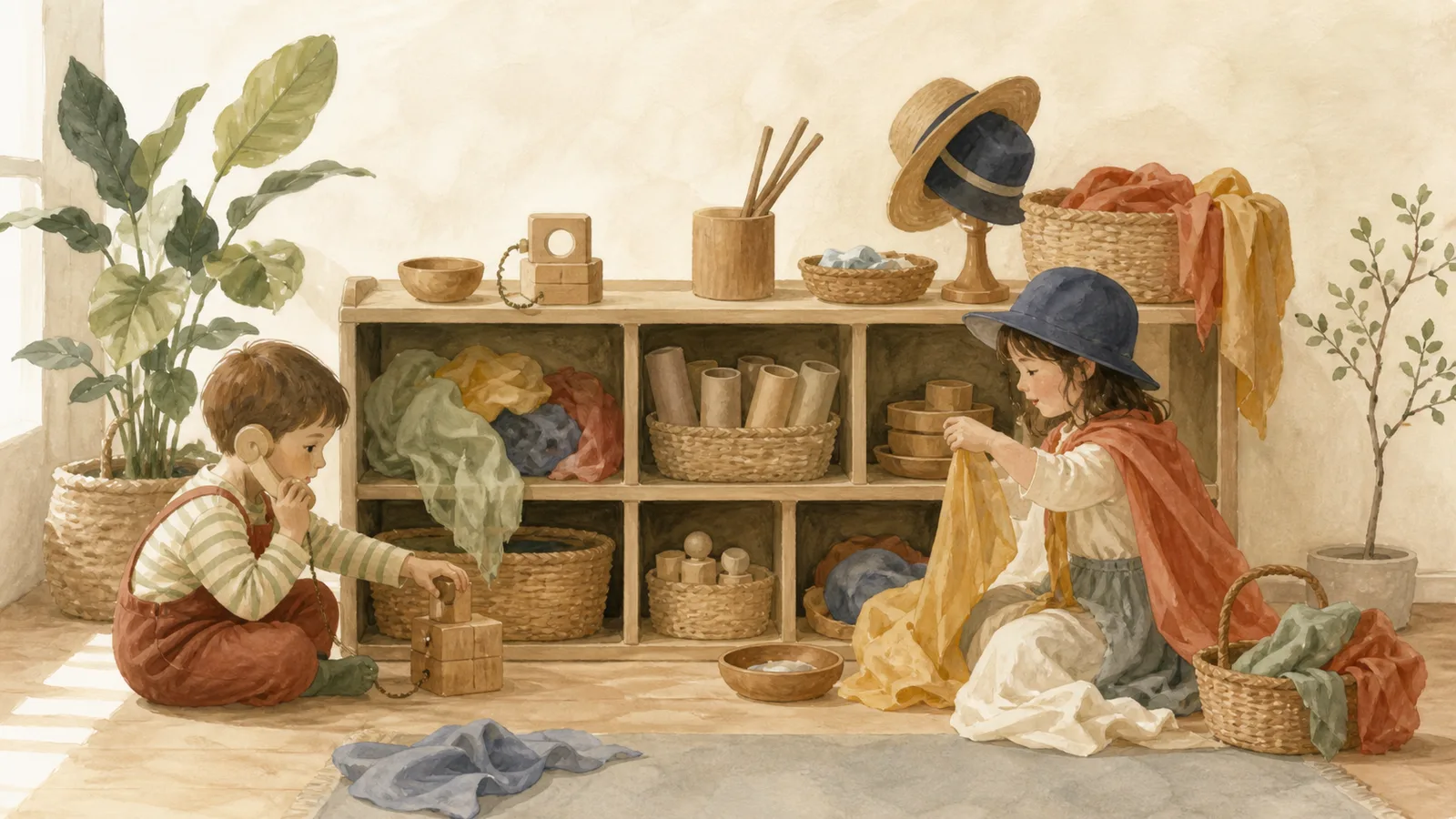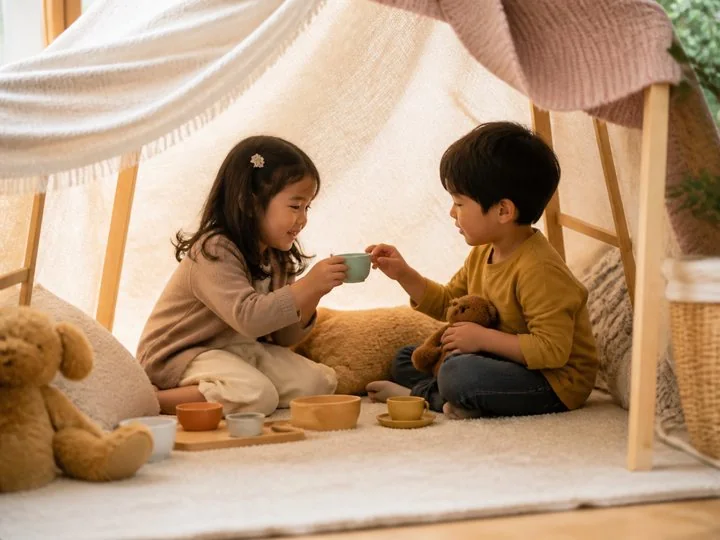
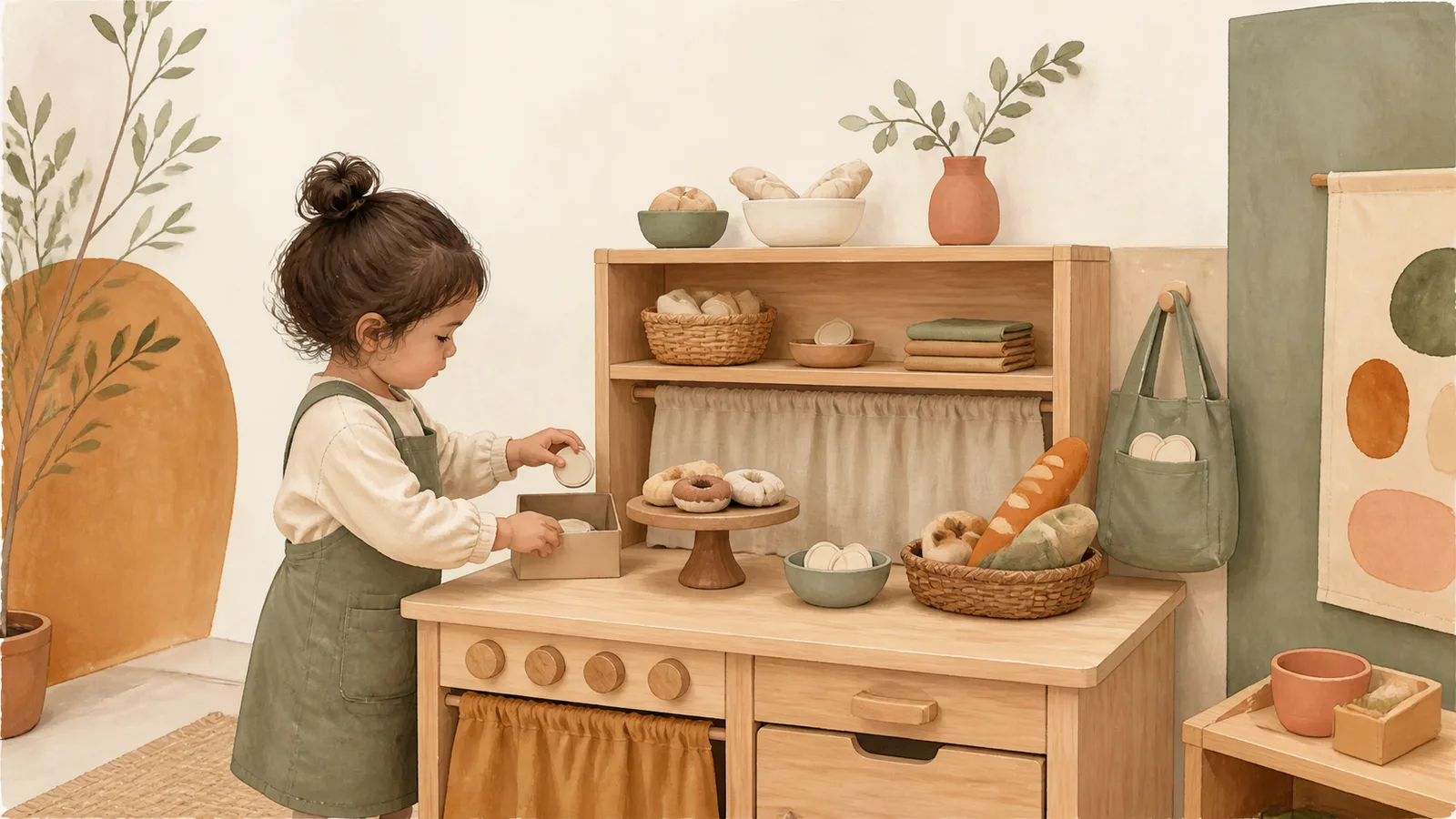
A play kitchen feels new when the work changes, not when another plastic ingredient arrives. Add one customer, problem, destination, or unusual material; keep the rest of the setup familiar.
Twelve low-prep kitchen stories
1. The five-minute bakery
Put two bowls, a tray, blocks as ingredients, and a cloth on the counter. The problem: three different customers need orders packed. Paper order slips are optional. A younger child can mix and carry; an older child can coordinate timing or invent dietary constraints without pretending those are real medical instructions.
2. Delivery kitchen
Nest bowls in a basket and choose two drop-off locations. Who checks the order, carries it, and returns the containers? This moves play beyond the kitchen and gives siblings separate jobs.
3. Leftover rescue café
Offer a deliberately odd set of pretend ingredients. The challenge is to create today’s special without rejecting any item. Keep the tone playful; this is not a lesson about forcing children to eat real foods.
4. Campsite cook station
Move one pot and a fabric square to the floor. Blocks become a safe unlit “fire.” Pack, cook, serve, then protect the food from a toy animal. Never use real flames or hot appliances in the play setup.
5. Test kitchen
Make two pretend versions of the same dish and compare invented qualities: crunchier, colder, taller, easier to carry. Children can draw a symbol for the version they choose, but no worksheet is needed.
6. Tiny restaurant
The customer is a small figure and every serving must fit its plate. This naturally changes scale and precision. Keep miniature items away from younger siblings.
7. Kitchen repair call
One door will not close, the sink is “blocked,” or the oven timer has stopped. Provide toy-safe tools or plain blocks as tools. The child may fix the appliance, redesign it, or declare a new use.
8. Washing station
Use a dry cloth and empty bowl for ordinary indoor play. If you add water, use a shallow amount on a wipeable surface and supervise continuously. Water is an optional sensory element, not what makes the story valuable.
9. Market returns desk
A customer brings back the wrong ingredient. The child can replace it, explain a policy, invent a new use, or route it elsewhere. This prompt generates negotiation without requiring money props.
10. Recipe from a picture
Choose a food image from a familiar book. Ask, “What would we need?” The picture is inspiration, not a model the final creation must match.
11. Celebration kitchen
Plan food for a doll’s birthday, an animal’s first flight, or the reopening of a bridge. Adding an occasion creates a reason to sequence work without prescribing the sequence.
12. Kitchen after closing
What happens when the customers leave? Restock bowls, decide where leftovers go, fold cloths, and set the counter for morning. This is an easy bridge into cleanup.
For more compact materials that can shift between these stories, see our open-ended prop guide. On days when a fixed kitchen feels stale, the broader rainy-day pretend-play ideas use forts, boxes, and household spaces.
The five-minute setup formula
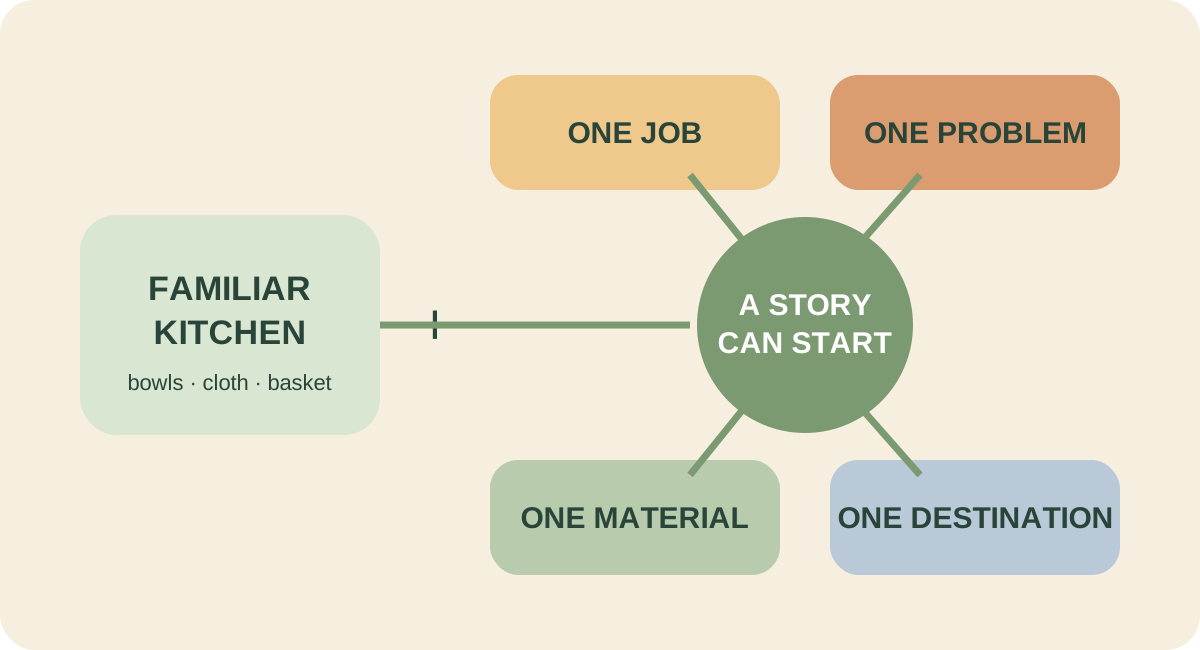
Use the kitchen the child already knows, then add only one:
- Job: packer, repairer, courier, tester, cleaner.
- Problem: missing bowl, narrow doorway, late delivery, tiny customer.
- Material: fabric, cardboard, blocks, a basket.
- Destination: campsite, upstairs café, animal hospital, train.
Stop before the scene looks complete. An immaculate adult-made display can make a child feel there is a correct way to use it. If the fabric intended as a tablecloth becomes a cape, the invitation worked.
Make it work in real homes
In a small space, store all accessories inside the kitchen or one basket. Photographing elaborate setups for later recreation creates work; a short note such as “delivery + basket” is enough.
For mixed ages, keep the accessible materials safe for the youngest. Give the older child planning authority without making them supervise hazards. For a child who avoids noisy group play, run a quiet takeaway window for one stuffed animal.
If your child insists you remain the customer, set a predictable limit: “I can order twice, then Bear will be the customer.” Move your lines to the toy and gradually reduce them. Our doctor-and-vet play guide uses the same strategy for adults tired of being the patient.
Literacy and math—keep them available, not compulsory
A child may want menus, receipts, signs, prices, or numbered tables. Supply paper when those tools serve the story. Do not interrupt a sustained café plot to quiz letters or require correct change.
Pretend kitchen play can provide opportunities for new words, sequences, comparisons, and negotiation. Evidence about pretend play does not show that a kitchen set uniquely causes language, math, or social outcomes. The value lies in the actions and interaction available—not an “educational” label.
Safety and cleanup
- Keep real medicines, cleaners, matches, batteries, sharp utensils, hot appliances, and breakables inaccessible.
- Check empty food packaging for sharp rims, plastic films, loose caps, allergens, and residue.
- Treat dry foods and sensory fillers as small-part and ingestion risks; they are unnecessary here.
- Remove long straps and cords from dress-up or delivery bags.
- End with one in-story job: return bowls, park the basket, fold the cloth.
Frequently asked questions
What age is a play kitchen for?
Follow the specific product’s age grading and consider reachable small parts, stability, and how the child plays. A child may imitate simple stirring before creating long role-based stories.
What if my child never uses the play kitchen?
Move two accessories to a table or floor and observe whether the fixed structure is the barrier. Some children prefer small figures, construction, real-life participation, or other forms of play.
Do I need pretend food?
No. Blocks, fabric pieces, bowls, and containers can represent ingredients. A few recognizable foods can make starting easier, but a full set is optional.
How do I stop the pieces spreading everywhere?
Set one boundary before play—a rug, room, or delivery route—and use one basket for mobile items. Choose ten useful accessories over a large mixed collection.
Sources and research note
Editorial decisions were informed by AAP guidance on pretend play and the clinical report The Power of Play, Penn State Extension’s practitioner guidance, and research on symbolic play as a context for language. Claims are bounded by the major evidence review of pretend play. Safety guidance follows the CPSC small-parts guidance.