

The right question is not “What age can a child play outside alone?” It is “Is this child ready for this route, in these conditions, with this plan?” A quiet enclosed courtyard and a trip across a multi-lane road demand different skills.
First define the privilege precisely
Write down the destination, route, boundaries, time, companions and check-in. “Outside alone” is too vague. A first plan might be: the shared courtyard between two entrances, for 15 minutes, with a visual check from the doorway and no leaving with another family.
Check current local law, housing rules and child-welfare guidance. U.S. rules vary; a legal minimum, where one exists, is not proof of developmental readiness.
The route readiness check
Traffic
Can the child stop at every edge, scan consistently, judge turning vehicles and resist following a peer? The American Academy of Pediatrics says children generally are not ready to cross streets alone until at least age 10. That is a general threshold, not automatic clearance at a birthday.
Navigation
The child can describe the route, identify safe landmarks, return by the same route and explain what to do if the planned path is blocked. Practice in ordinary and slightly changed conditions—but not during a real emergency.
Boundaries and time
The child repeats where they may go, whom they may accompany and when they return. They can stop an enjoyable activity when the timer or agreed cue occurs.
Help-seeking
The child knows caregiver contact information, how to identify an appropriate helper and how to respond if lost. Practice saying, “I need help contacting my parent,” rather than relying only on stranger-danger slogans.
Judgment under pressure
Ask scenario questions: a friend suggests a different park; a ball rolls into the road; the phone dies; an adult asks for help; weather changes. Look for a safe process, not memorized perfect wording.
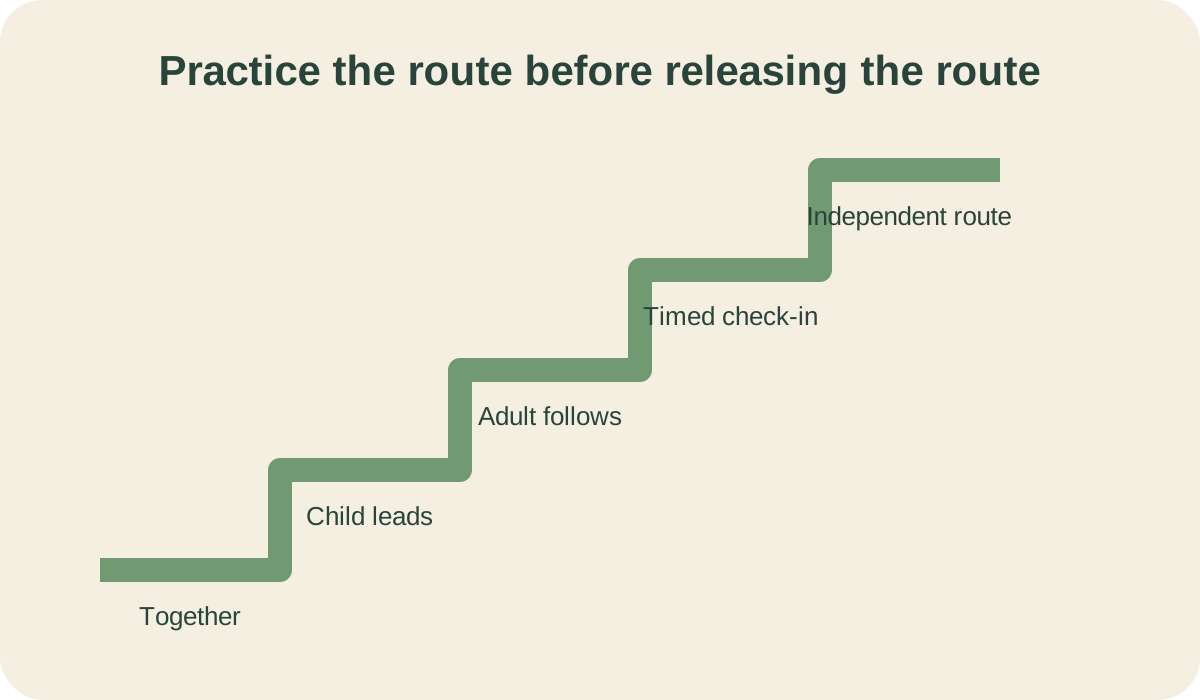
A five-step rehearsal
- Travel together. The adult narrates only essential decisions.
- Let the child lead. They choose stops and explain hazards while the adult stays beside them.
- Follow behind. The adult observes without prompting unless safety requires it.
- Separate briefly. Use a contained area and a timed visual or verbal check-in.
- Release the rehearsed route. Keep the first independent trip short and predictable, then review what happened.
If a step exposes a skill gap, return to practice. This is information, not failure. Our guide to building independence through play offers lower-stakes ways to practice planning and recovery.
Phones, trackers and siblings
A charged phone can support contact, but batteries fail, coverage drops and children may freeze or become distracted. Teach the no-device plan first. Location tracking changes what adults know; it does not change traffic speed or a child’s decisions.
An older sibling arrangement should be assessed for both children. Can the older child handle their own safety without being made responsible for parenting? Will conflict change the route? Two unready children do not become one ready unit.
Conditions can revoke readiness for today
Darkness, storms, smoke, extreme heat, construction, crowds, unfamiliar dogs, icy surfaces and special events can change a familiar route. So can illness, distress or fatigue. Independence should be reversible without shame.
The all-season outdoor guide covers environmental checks. Risky play is a related but different decision: read how to separate manageable challenge from hidden hazards.
A simple family agreement
- exact permitted area and off-limit areas;
- return time and check-in method;
- what to do if the plan changes;
- three approved helpers or places;
- traffic and water boundaries;
- whether friends may join or invite the child elsewhere;
- consequence for a missed check-in that prioritizes safety, not secrecy.
Review after the outing: What felt easy? What changed? Where did you pause? The goal is shared learning, not catching mistakes.
Frequently asked questions
Is age 10 the rule for all outdoor play?
No. The AAP’s general statement concerns crossing streets alone. A contained no-road setting may be different; a complex route can require more maturity and adult support.
Is a mature eight-year-old ready?
Possibly for a tightly bounded space, but do not generalize that to independent street crossing. Evaluate and rehearse the exact privilege.
What if other families allow more freedom?
Use your child’s demonstrated skills, route and local context. Explain the next practice step so the boundary feels purposeful rather than arbitrary.
Sources and research note
Traffic guidance comes from the AAP Pedestrian Safety policy statement and parent-facing street safety guidance, with route context from NHTSA. Legal variation is summarized by the U.S. Child Welfare Information Gateway’s home-alone guidance. Local rules and an individual child’s needs must be checked directly.