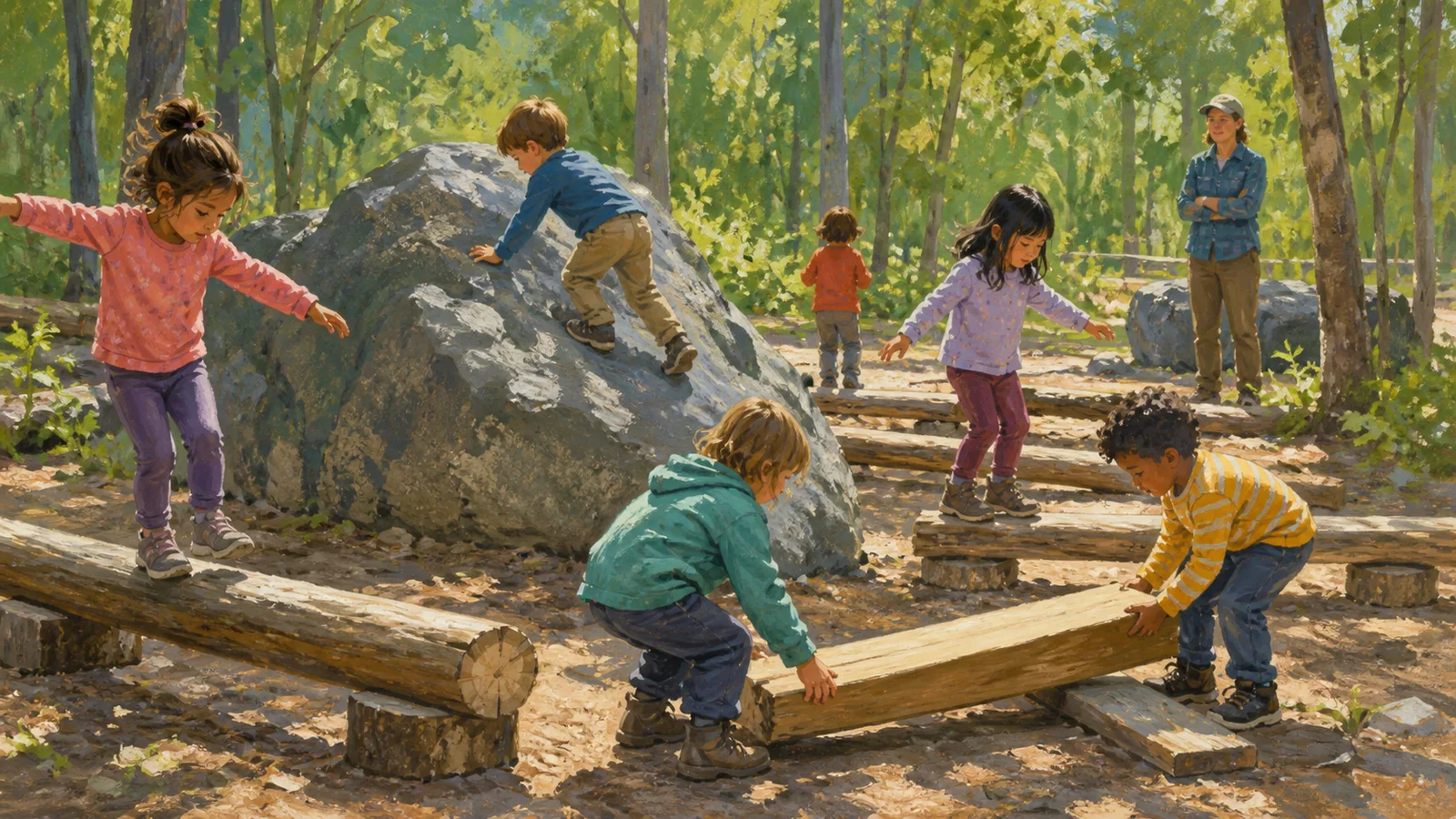
Risky play is thrilling, uncertain play in which a child can test a challenge: climbing, balancing, moving fast, exploring distance, using tools or play-fighting. It is not a polite name for exposing children to hazards.
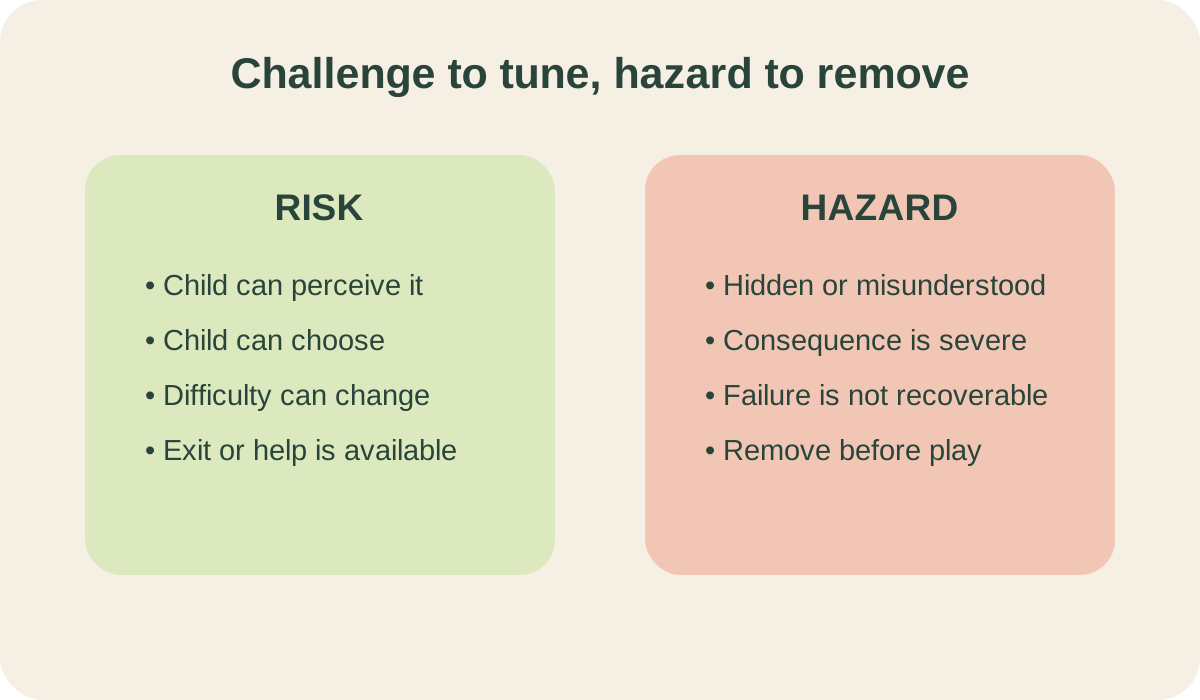
Risk and hazard are different jobs
A low log may present a visible balance challenge. A rotten section that can collapse is a hidden hazard. A child can decide whether to step onto the log; the child cannot assess internal decay.
| Ask | Keep and tune the challenge | Remove or stop |
|---|---|---|
| Can the child see the difficulty? | Height, speed or wobble is apparent | Danger is concealed or misleading |
| Can the child opt out? | There is a real pause or exit | Peers/adults pressure participation |
| Is failure recoverable? | A stumble lands on a suitable surface | Fall reaches traffic, water or a severe drop |
| Can help arrive? | Adult knows location and can assist | Rescue is delayed or impossible |
| Are conditions stable? | Dry, intact, inspected equipment | Ice, damage, entrapment, sharp edges |
Removing the hazard need not remove the play. Move the log away from traffic, lower the starting point, clear the landing or offer a hand for the first pass.
What research actually says
A 2015 systematic review included 21 papers on risky outdoor play and health. The authors found overall positive relationships, including with physical activity and aspects of social health and behavior, while also rating much of the evidence as low or very low quality. Study definitions and designs varied.
A 2024 Canadian Paediatric Society position statement synthesizes later evidence and encourages access to outdoor risky play. That is useful context, but it does not mean a particular climb causes resilience or that injuries are beneficial. Associations, expert synthesis and plausible mechanisms should not be turned into guarantees.
The practical conclusion is modest: children need opportunities for active, self-directed challenge, and adults still need to manage hazards.
Use a five-part check
Child
What has this child done before? Can they communicate stop, follow the site boundary and recover when excited? Fatigue, hunger, medication, sensory overload and recent illness can change capacity today.
Task
What is uncertain—height, speed, balance, tool control, distance or social contact? Change one variable at a time. A higher surface plus wet shoes plus a crowded landing is not one challenge.
Site
Inspect anchors, surfacing, traffic, water, visibility, broken equipment, sharp material, head-entrapment gaps and other users. CPSC playground guidance is designed around equipment and public settings; it does not certify a homemade setup.
Consequence
Scraped knees are different from head injury, drowning, strangulation, burns or vehicle impact. The more severe the plausible consequence, the less room there is for uncertainty.
Support
Decide where the adult stands, what phrase means stop, and how rescue works. “Be careful” offers little information. Try: “That branch bends,” “I will stand by the edge,” or “Show me where you plan to land.”
When adults should intervene
Intervene when the child cannot see the danger, consent has disappeared, conditions have changed, the consequence is unacceptable, or the child is no longer controlling the action. Stop aggressive play when someone says stop, cannot leave, is targeted repeatedly, or cannot distinguish play from harm.
Pause rather than escalate when a child freezes. Ask what they notice and whether they want a lower version, a hand or to finish. Completing the highest version is not the measure of success.
Inclusion without removing all challenge
Equal play does not require identical equipment. A child with limited mobility may choose speed on an accessible slope, uncertain textures on a trail or leadership in route planning. A child with low vision may need tactile boundary markers and a preview. A child who processes language slowly may need a visual stop signal.
Adapt the information and consequence, then preserve real choice. The U.S. Access Board’s play-area guidance is a useful baseline for accessible routes and components, but individual access goes beyond minimum compliance.
Frequently asked questions
Is climbing furniture risky play?
Not automatically. Tall unsecured furniture, windows and tip-over hazards are household hazards, not development opportunities. Use purpose-designed equipment in an appropriate area.
Should I say “be careful”?
Specific information is more actionable: “The rock is wet,” “Two children are below you,” or “Where will your foot go next?”
What if my child avoids risk?
Do not force it. Offer predictable, low-consequence variations and let observation count. Temperament, disability and prior experience affect participation.
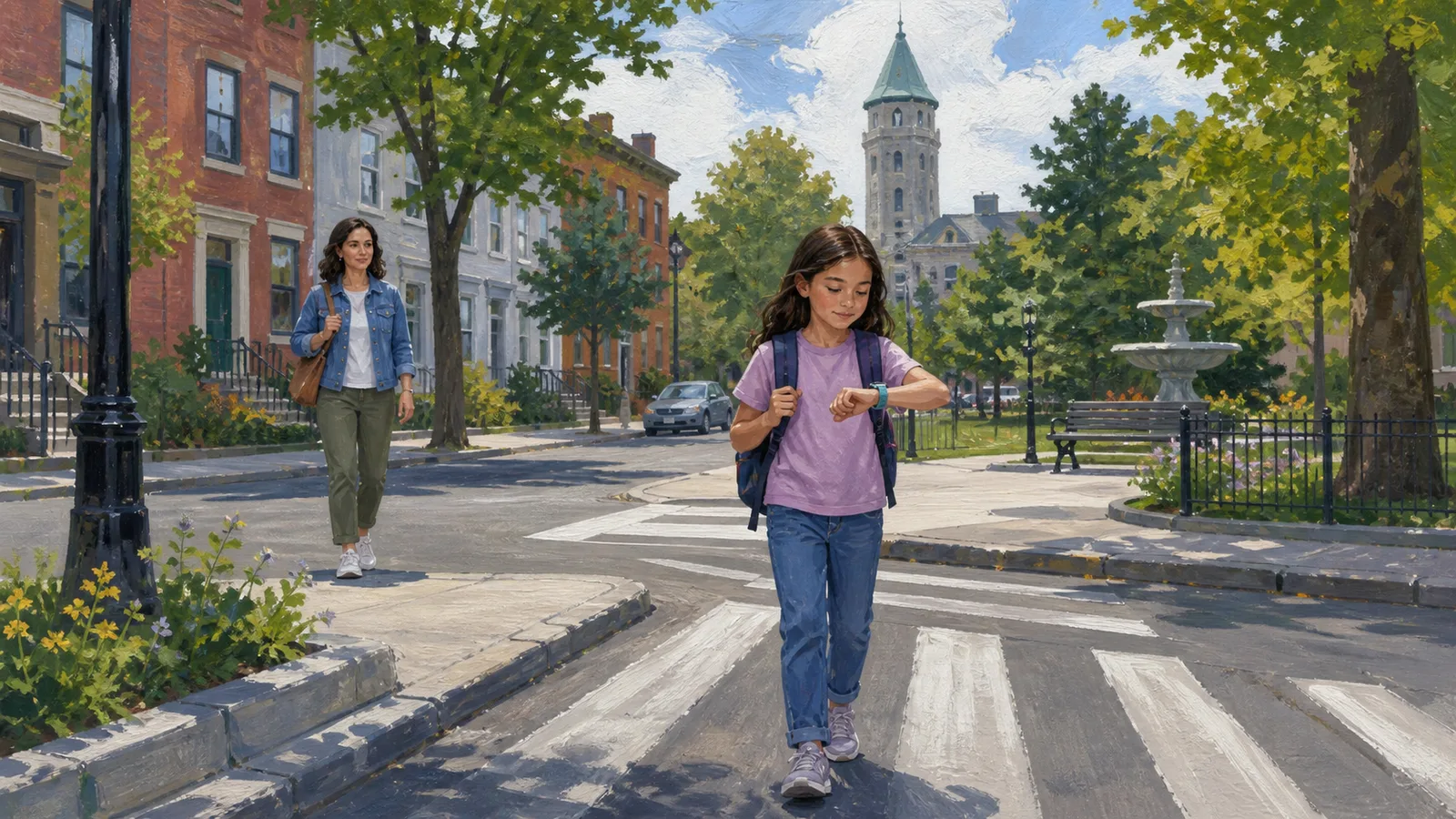
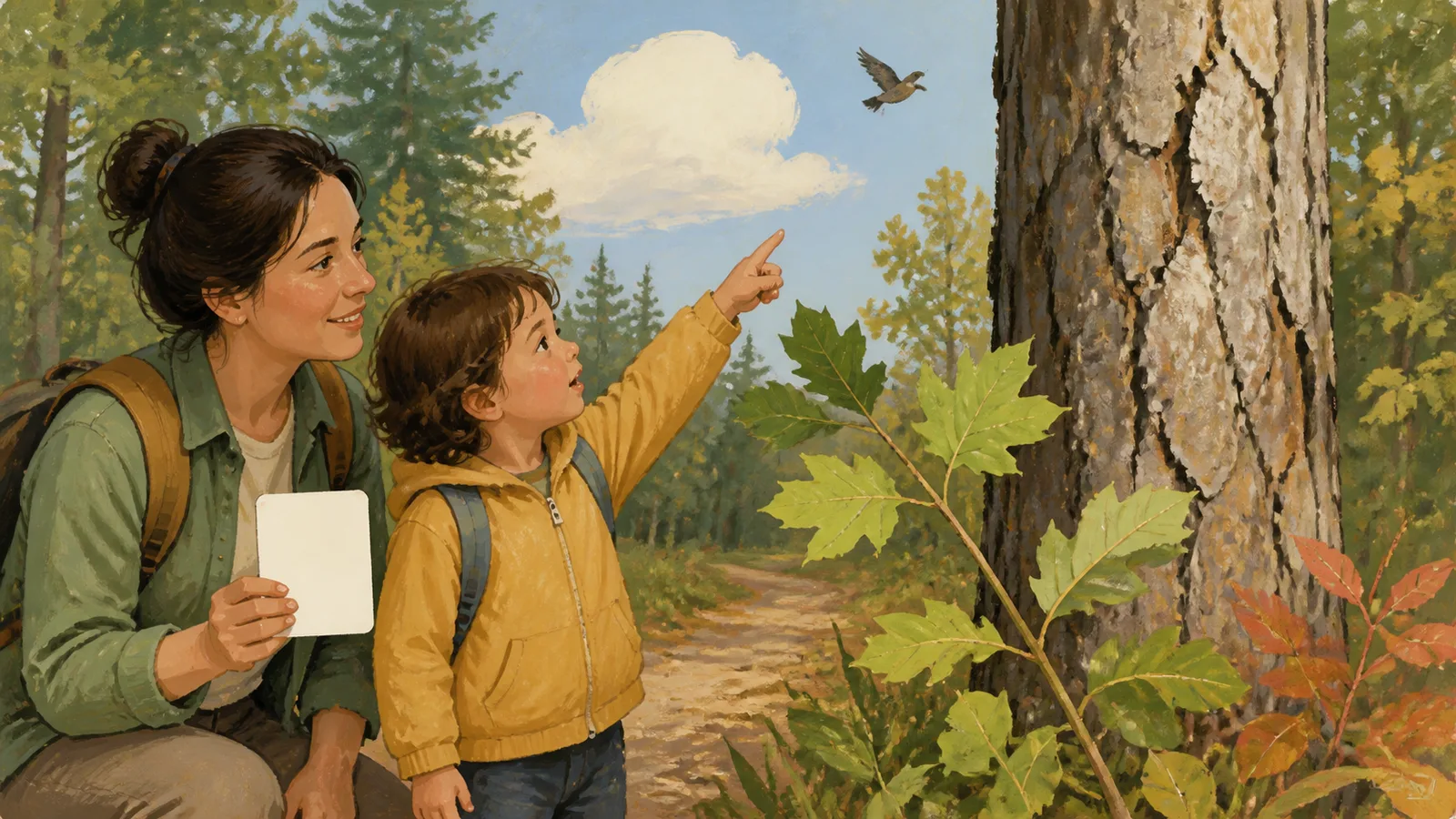
The next step toward greater range is not necessarily unsupervised freedom. Our outdoor-independence readiness guide separates route skills and communication from play challenge. For a gentler outdoor invitation, try a no-collection nature hunt.
Sources and research note
For independent travel, use the separate outdoor independence readiness guide; for a gentler observation challenge, try a preschool nature hunt. Families working with limited outdoor space can also use the constraints in our small-space outdoor toy guide.
Evidence interpretation centers on the 2015 systematic review of risky outdoor play and health and the Canadian Paediatric Society’s 2024 position statement. Site and injury context draws on the CPSC Public Playground Safety Handbook, a systematic review of playground injuries, and the U.S. Access Board play-area guide. This article does not establish an injury-free threshold or individual readiness.