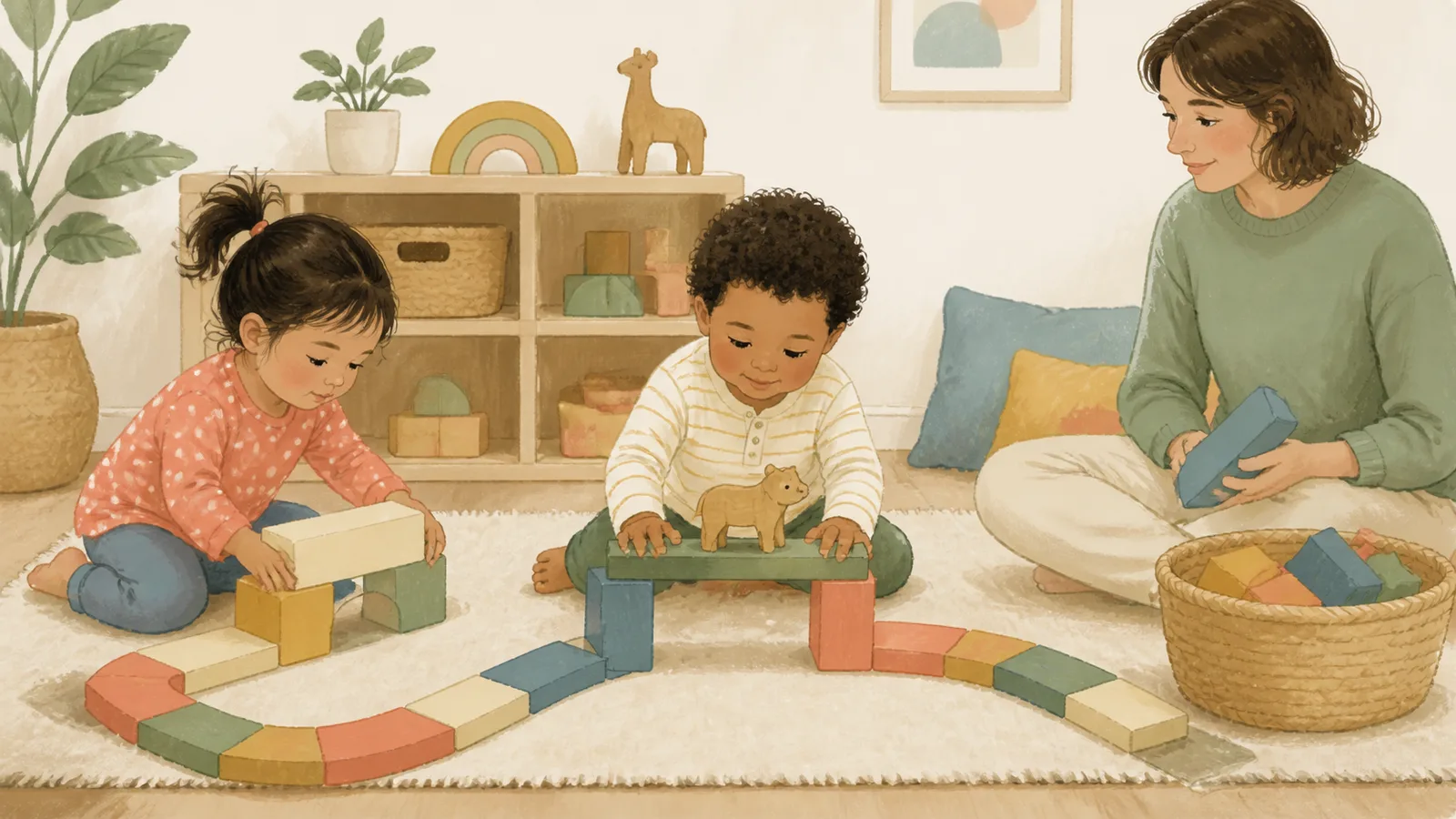
“Can you build a castle?” sounds open-ended to an adult but may still prescribe a result a toddler cannot picture or does not want. A better prompt starts with an action: Can these blocks make a path? What could go over this gap? Where might the animal sleep?
The child can answer with one block, ten blocks, a new story, or no answer at all. The prompt opens play; it does not become an assignment.
Set up less than you think
Place 8–16 age-suitable blocks on a rug or clear floor. Add one optional item: a large animal, vehicle, ball, cardboard tube, or short cloth. Keep the rest of the accessories away until the construction has a chance to begin.
For a child still dropping or throwing, begin with lighter blocks. Our first-block guide compares weight, surfaces, connection, sound, and storage.
Choose a prompt by action
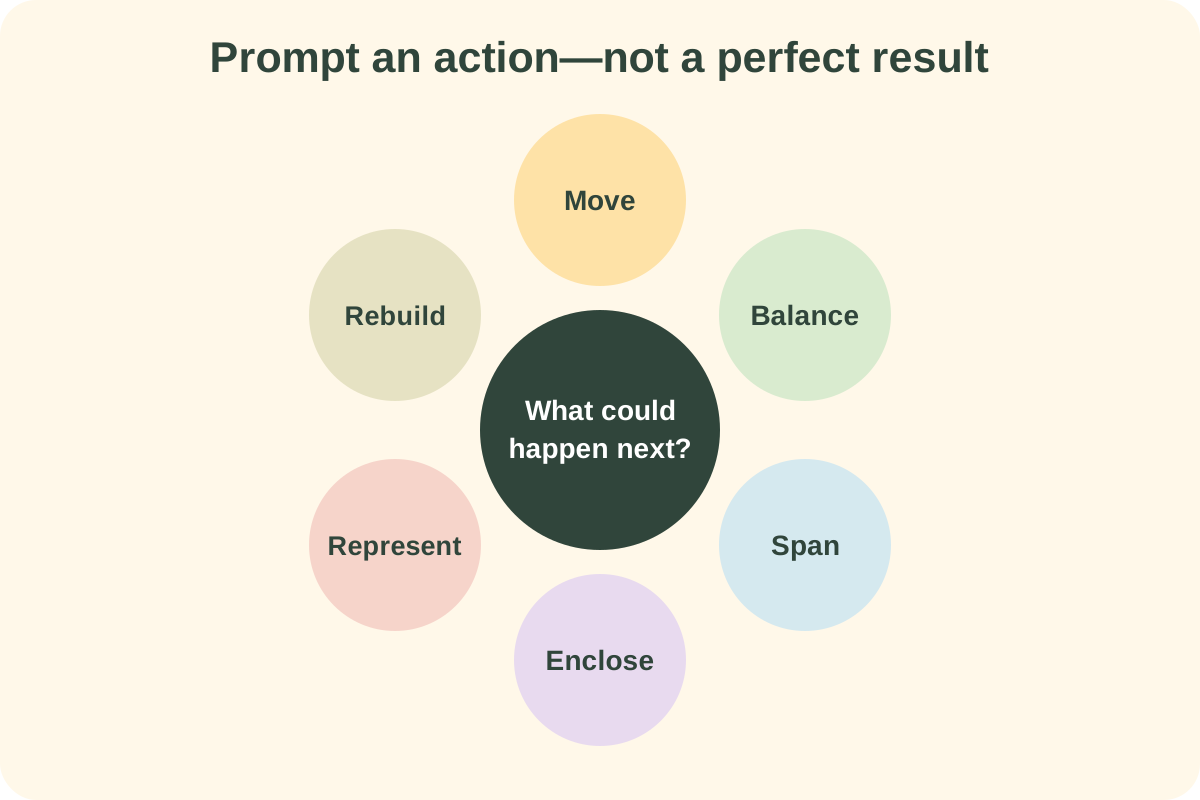
Move and arrange
- Make a road from the rug to the shelf. The road may be a line, scattered stepping stones, or a wall.
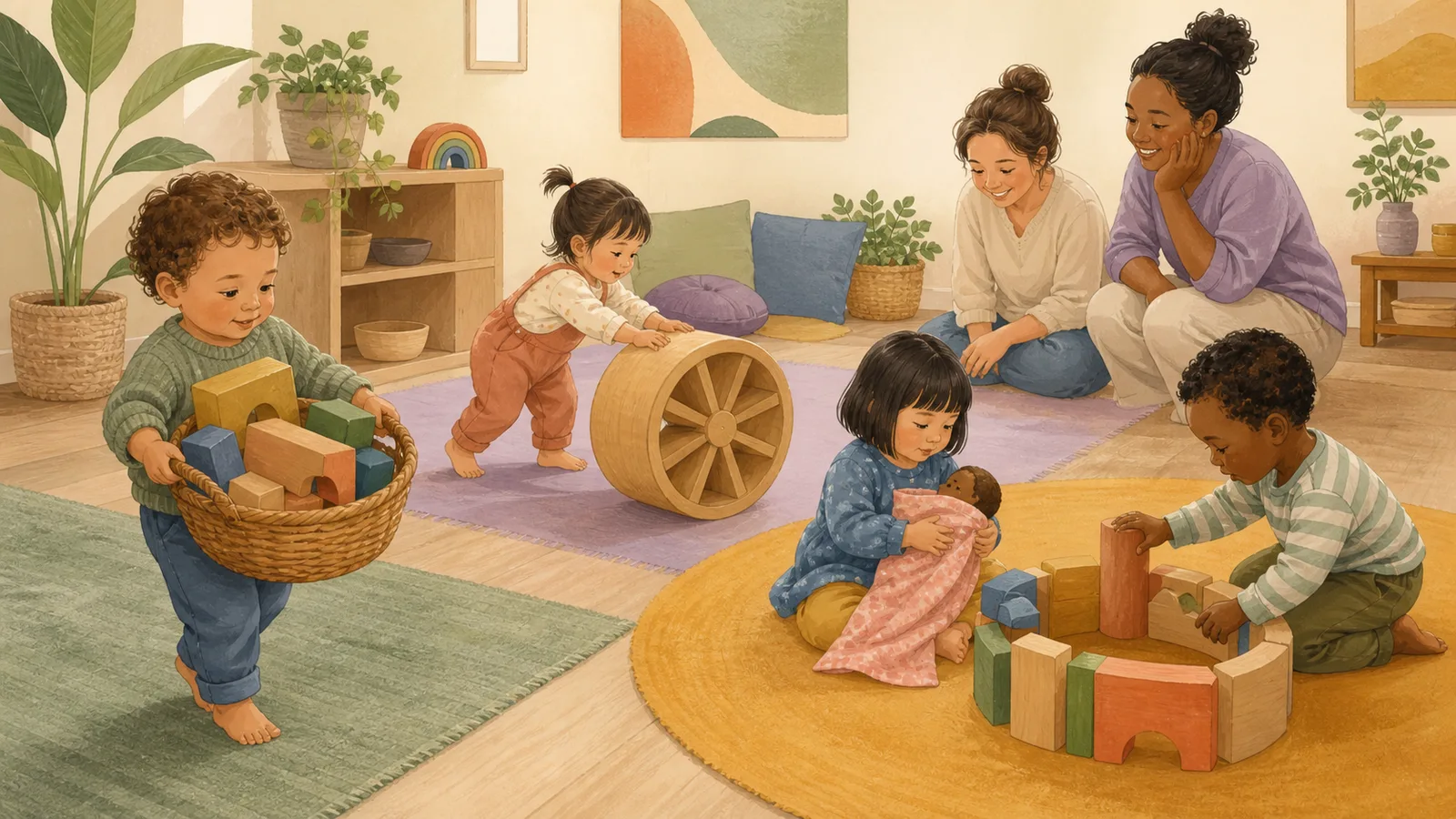
- Deliver three blocks in a basket. This suits a child more interested in carrying than stacking.
- Find every block that can roll. Try on the floor or down a very low stable ramp.
Use ordinary observations: “The cylinder kept moving,” or “Your road bends.” Do not require the child to name shapes.
Balance and stack
- Can one block stand on this small face? Let it fall; instability is the information.
- Build something as tall as the toy animal. The animal is a reference, not a ruler test.
- Make a tower with a wide bottom. What happens if the bottom is narrow? Try both if the child is interested.
When the child knocks the structure down, pause before rebuilding. They may repeat the collapse several times. Keep people and breakable objects out of the fall zone.
Span and bridge
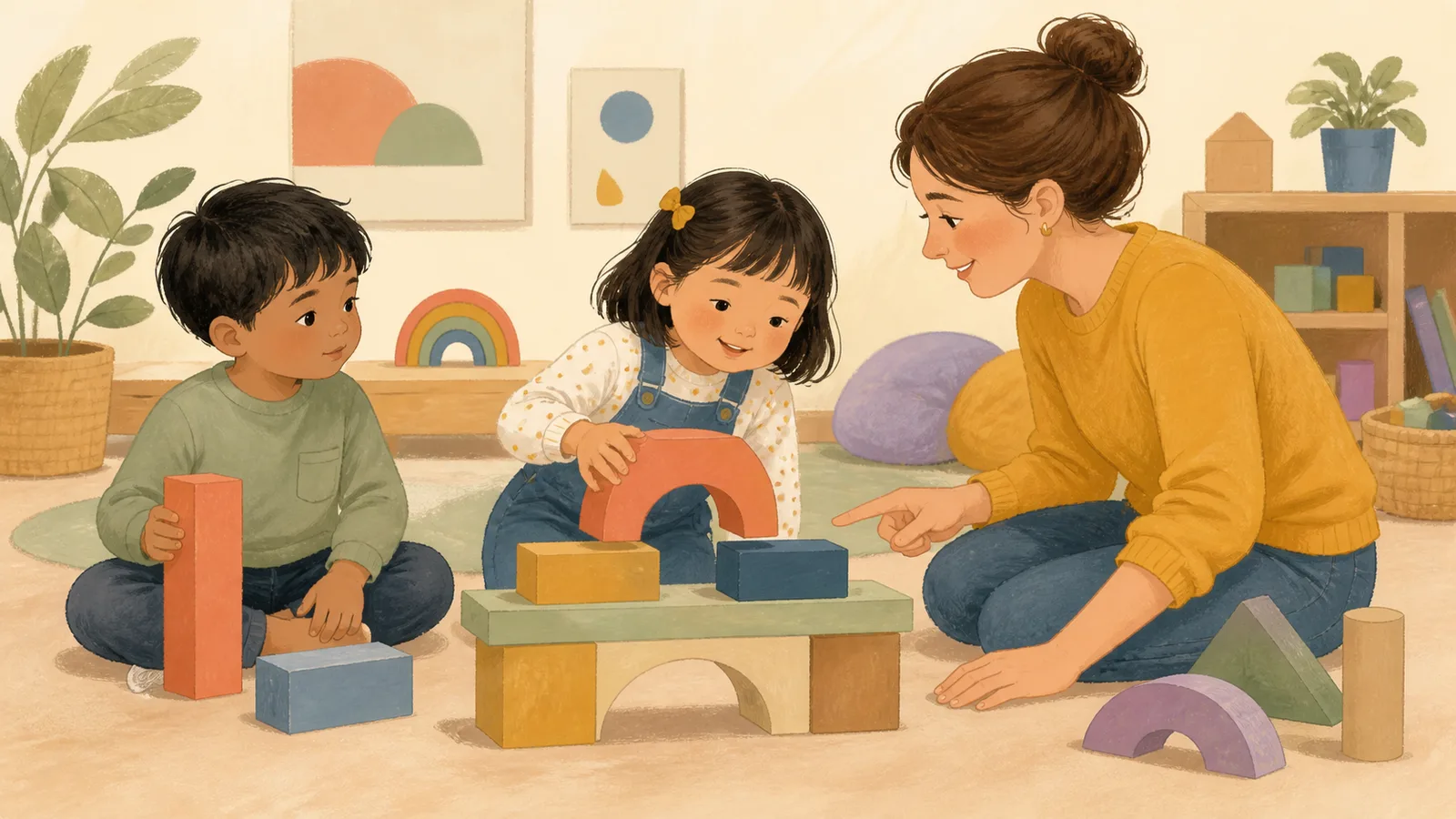
- Put two blocks apart. Can another reach across? Start with a short, obvious gap.
- Make a bridge the animal can go under. If the figure is too tall, let the child decide whether the bridge or story changes.
- Cross a blue cloth “river.” Lay the cloth flat and short so it creates no neck loop.
NAEYC describes bridge construction as something that often appears after simple stacking and may first be copied from an older child or adult. That is a broad observation, not an age deadline.
Enclose and contain
- Make a sleeping place for one animal. Three blocks can be enough.
- Build a fence with one opening. The opening introduces inside, outside, through, and beside.
- Can the basket fit inside the block boundary? Change either the boundary or the object.
Children who repeat boundaries may also enjoy the enclosing patterns described in our play-schema guide.
Represent and tell a story
- This one block is a bus. Where will it stop? Representation begins without constructing anything recognizable.
- Make a table for the animal’s snack. A flat block on supports may become a table, bed, or stage.
- Where does the road go when it reaches the wall? It can turn, climb a low block, or finish.
Accept the child’s premise. A cylinder can be a baby and an arch can be soup. Naming the “correct” object reduces the flexibility that makes block play useful.
Collaborate and rebuild
- You place one block; I’ll place one. Stop if turn-taking interrupts the child’s plan.
- Can we join your road to mine? Ask before altering the child’s structure.
- Which part should stay when we rebuild? Preserve one section and change another rather than clearing everything.
What adults can say
Spatial language during block play includes location, dimension, shape, properties, and orientation. Research has observed these words in children’s natural block play, but adults do not need to deliver a geometry lesson.
Try:
- “The long block is under the bridge.”
- “You turned the arch around.”
- “There’s a narrow space between those two.”
- “That side looks higher.”
- “The round piece rolled away.”
- “I wonder what could make it steadier.”
Then wait. Our deeper guide to spatial language in block play explains how description and genuine questions differ from constant testing.
When the adult keeps becoming the builder
If the child repeatedly says “You do it,” build one small element and return a decision: “I made two supports. Which block might go across?” You can also build beside the child rather than inside their project.
Avoid rescuing every unstable tower. A collapse within a safe setup provides immediate feedback. Intervene when weight, height, throwing, climbing, or conflict creates risk—not because the result is crooked.
When the child dumps and leaves
Use fewer pieces and connect the dump to the next action. Place four blocks in a basket at one end of a tape-free route and an empty tray at the other. The child may transport them. Or build a two-block tower beside the pile and see whether knocking down becomes the entry point.
If the child leaves, the invitation may simply be wrong for that moment. Do not keep demonstrating more elaborate structures to prove the blocks are interesting.
Siblings and shared structures
Give each child a zone plus a possible connection. One toddler builds a road; an older child builds a bridge that may cross it after asking. Shared goals work better when neither child must surrender the entire plan.
Use materials safe for the youngest child in the shared space. Keep miniature bricks, loose magnets, complex connectors, and small figures at a separate higher workstation with closed storage.
Saving a build in a small home
Not every project can remain on the floor. Offer one tray or low board as the “save space.” A build that fits can remain until the next day; everything else resets. Take a photo only if the child values it. Some children enjoy demolition more than preservation.
Store blocks by compatible system rather than shape. If every rectangle and arch has its own bin, cleanup becomes an adult classification task. One complete basket makes it easier to begin again.
Frequently asked questions
What age are these prompts for?
They suit many children from roughly 18 months through preschool with different levels of support. Use the product’s age grading and the child’s current actions. A younger child may carry and knock down; an older child may bridge and represent.
Should I demonstrate first?
A small demonstration can reveal an action, especially bridging or balancing, but stop before creating a polished model. Leave the interesting decisions unresolved.
How long should block play last?
There is no target. A five-minute transport-and-dump session can be meaningful. Keep blocks accessible enough for return visits rather than stretching one session past interest.
Are magnetic tiles blocks?
They are construction materials but behave differently: connections hold, surfaces are thin, and magnetic enclosures require inspection. The prompts can transfer, but follow the tile set’s age and safety instructions.
Does adult guidance make block play less creative?
It depends on the guidance. A systematic review of guided play found varied effects and emphasized both child choice and adult support. A light prompt, useful word, or environmental change can extend play; prescribing the result or correcting every choice can take control away.
Sources and research note
The prompt design draws on NAEYC guidance about toddler block construction and block-play possibilities, research on children’s spatial language during block play, and a guided-play systematic review. Intervention studies report some positive outcomes but do not show that any one prompt causes development. Safety follows CPSC toy guidance.