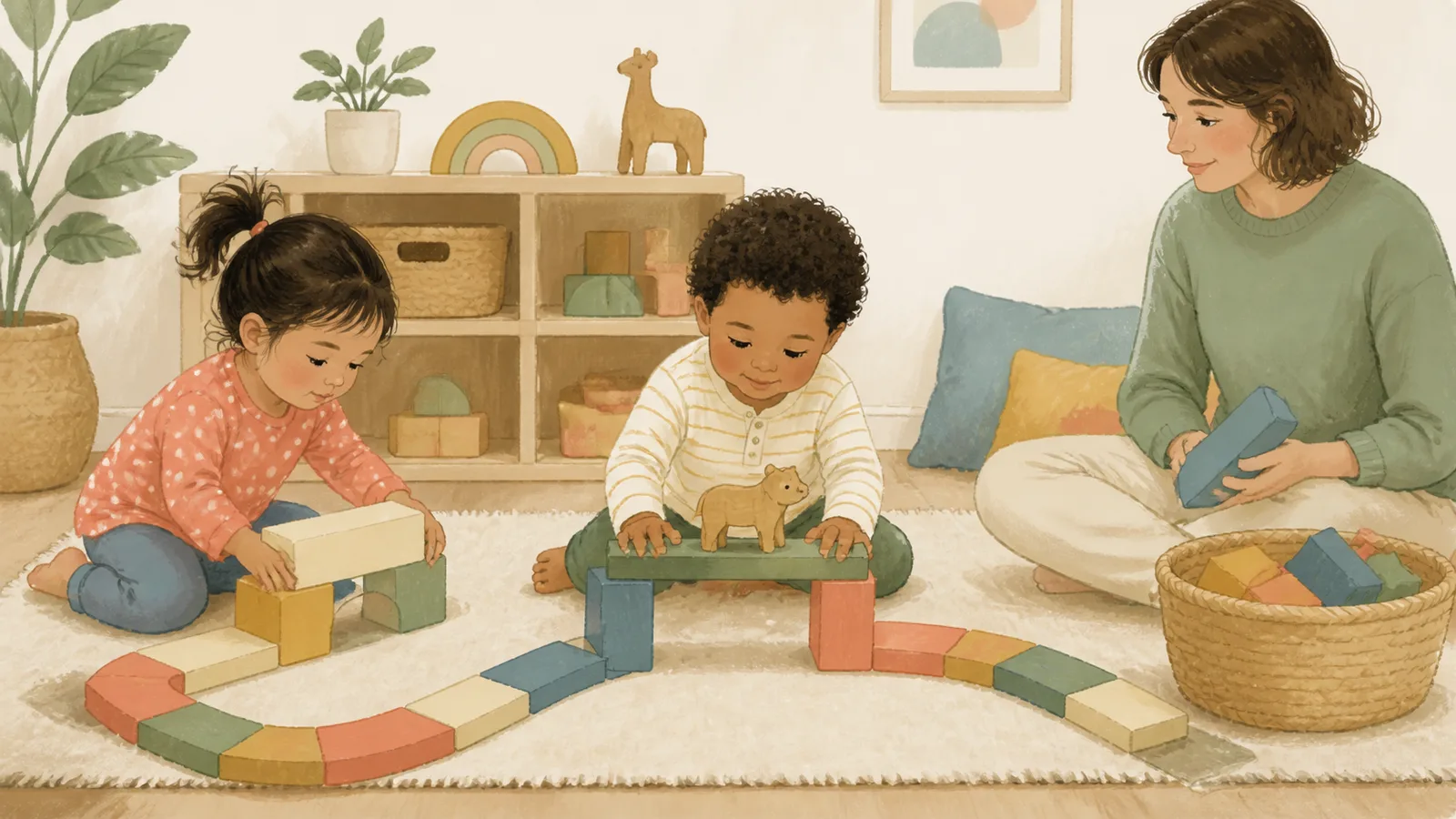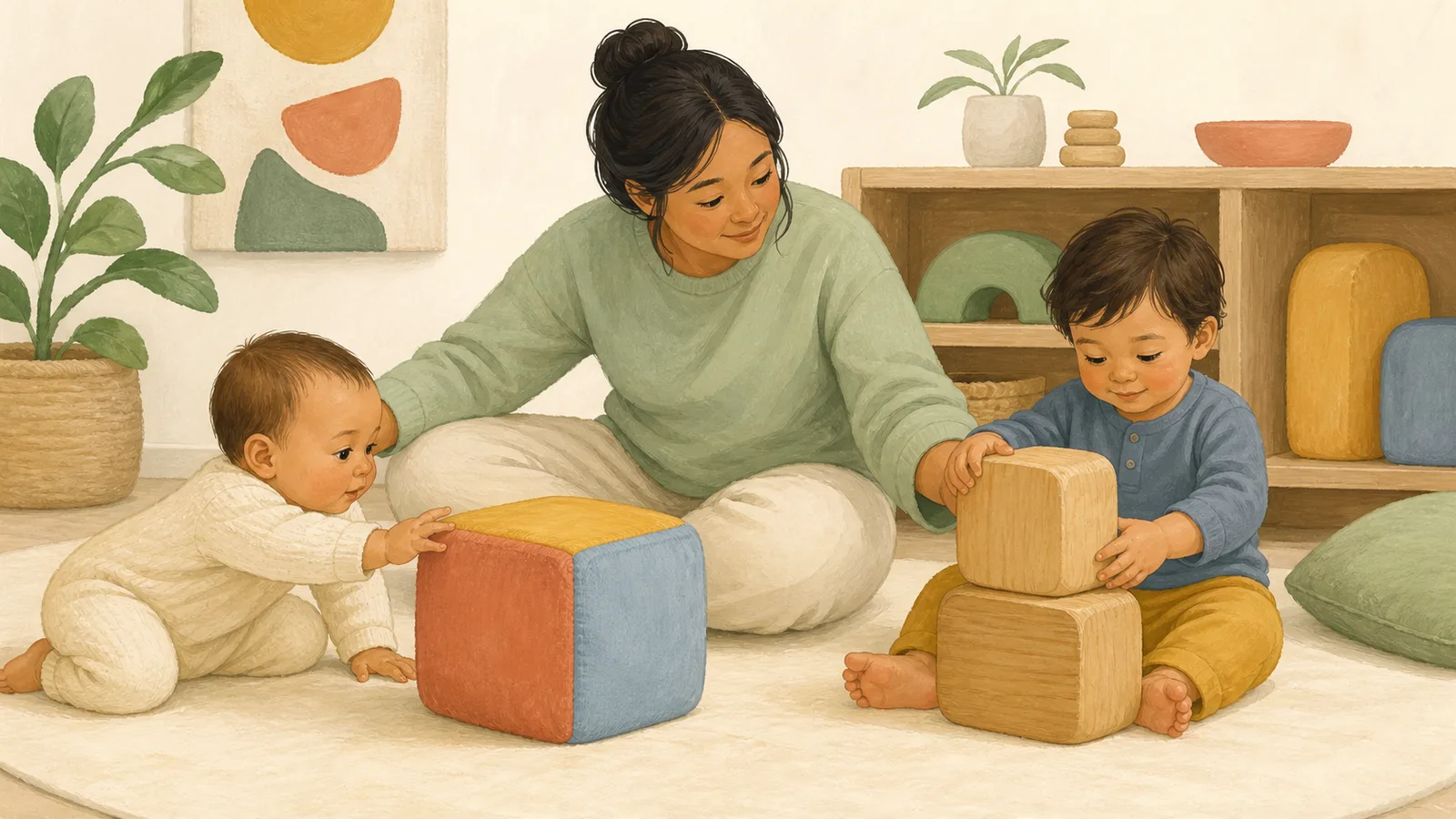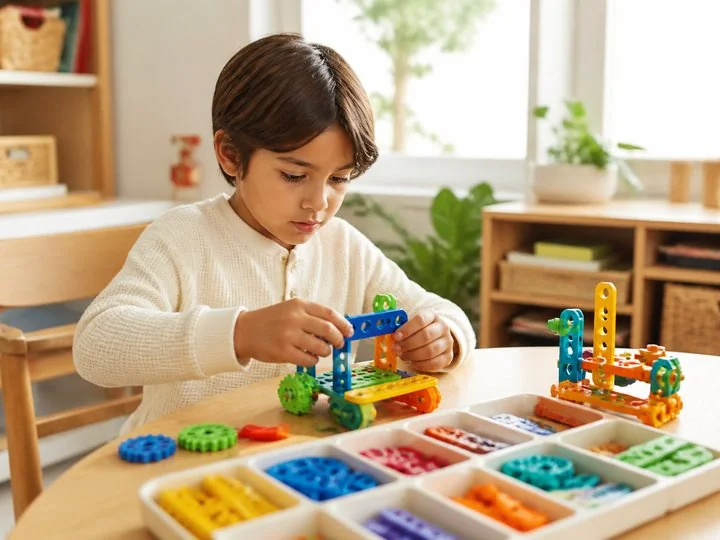
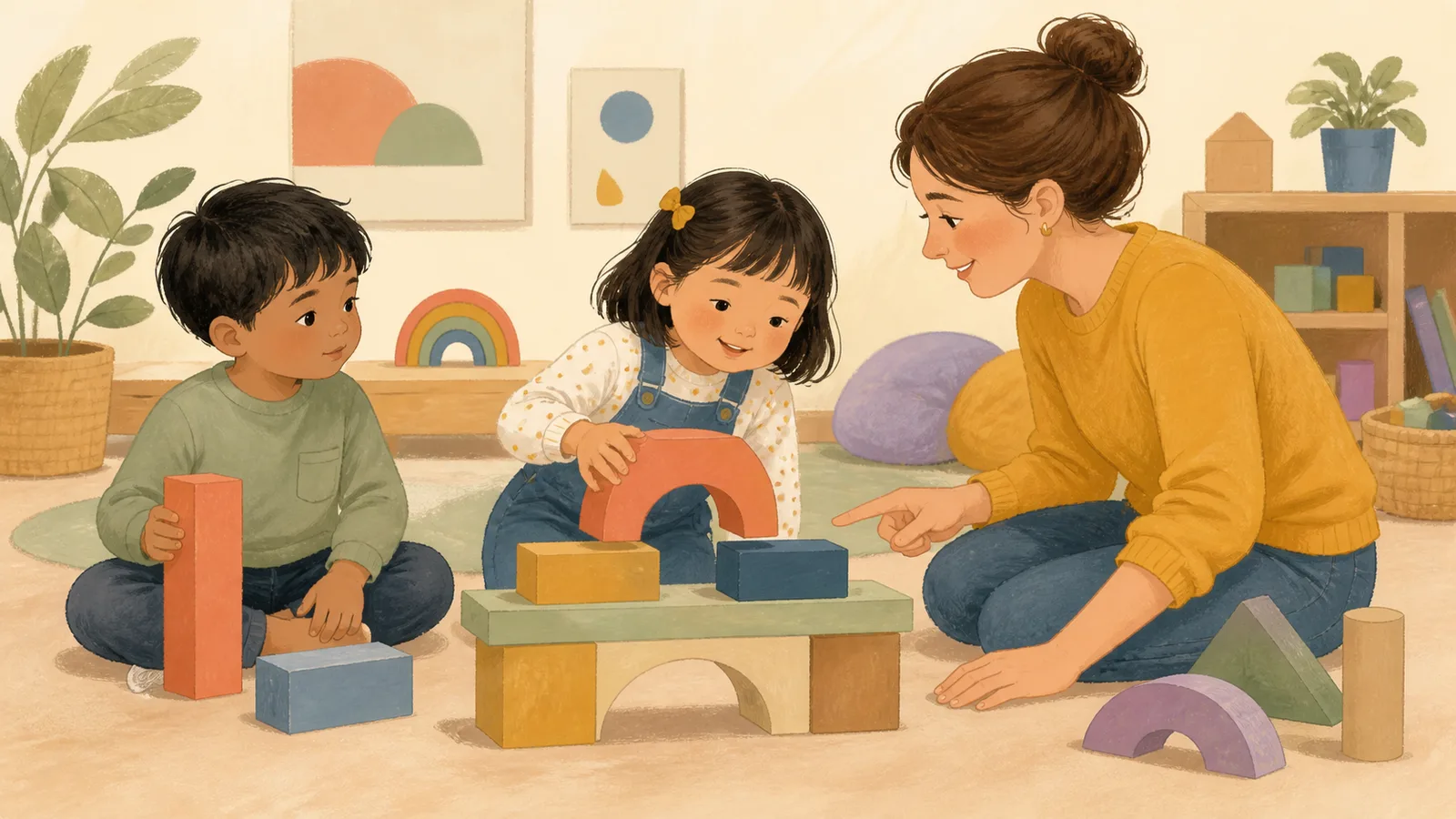
Spatial language gives children words for relationships they can already see and change: a block is under a bridge, one tower is taller, an arch curves, and a long piece must turn to fit.
The goal is not to say as many geometry words as possible. Use a precise word when it helps describe the child’s action, solve a shared problem, or remember what happened. Then leave space for play.
Six useful word families
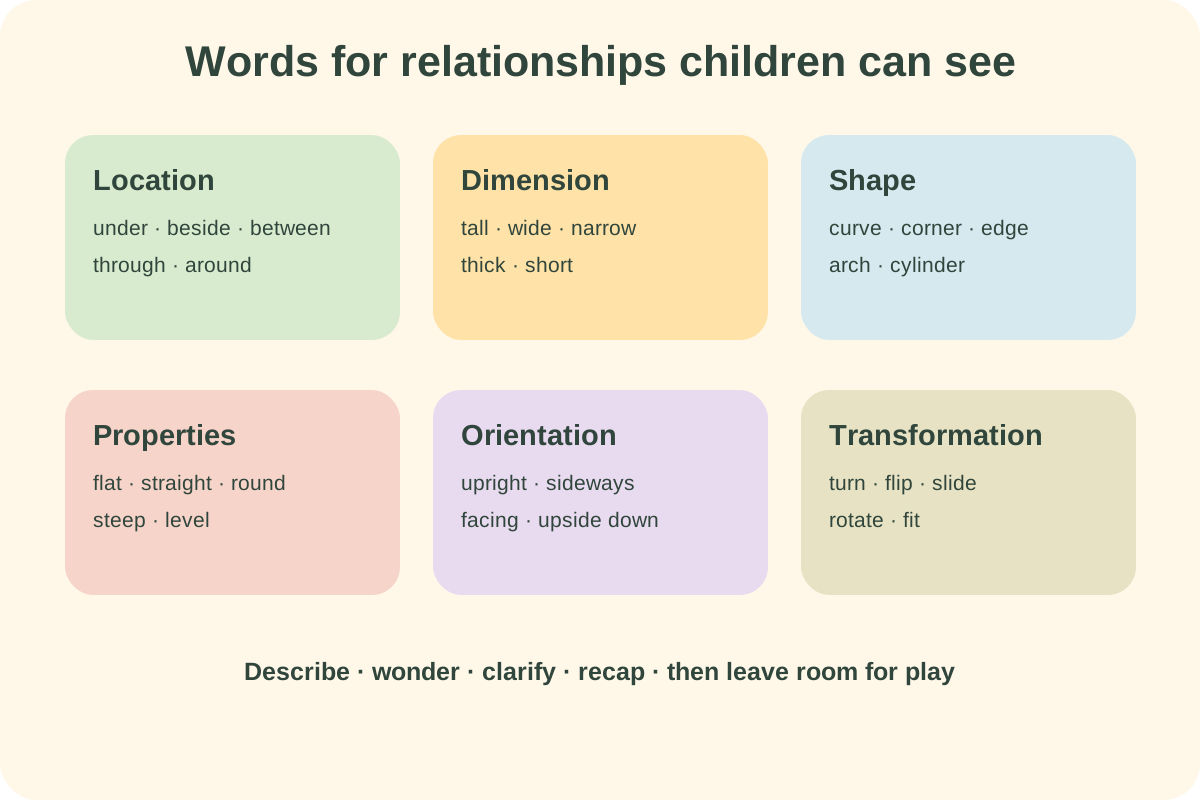
| Family | Examples | Natural block-play phrase |
|---|---|---|
| Location | in, on, under, over, beside, between, through | “The animal went under your bridge.” |
| Dimension | tall, short, long, wide, narrow, thick, thin | “This road gets narrower near the box.” |
| Shape | curve, corner, side, edge, arch, cylinder | “The arch has a curved top.” |
| Properties | straight, flat, pointy, round, steep, level | “That flat face made a steady base.” |
| Orientation | upright, sideways, upside down, facing | “You put the cylinder sideways.” |
| Transformation | turn, flip, slide, rotate, fold, fit | “You turned it until the edges matched.” |
Children do not need to repeat the word. Hearing language attached to an immediate action is already a meaningful exchange.
What the research actually says
A 2021 observational study recorded 228 children during free block play in urban Chinese kindergartens. Researchers coded language about location, deictic terms such as here and there, dimensions, spatial properties, shapes, and orientation or transformations. Location terms appeared most often, and gestures frequently accompanied deictic words.
That study shows what spatial talk looked like in those classrooms and how it related to levels of block play. It does not prove that adding a daily quota of spatial words causes stronger spatial ability. Its setting, language, and observational design matter.
Experimental and intervention studies of guided block play provide some evidence that adult support and structured challenges can affect spatial or mathematical talk and performance. Results vary by outcome and design. The responsible practical conclusion is modest: block play creates useful occasions for spatial conversation, and adults can make that conversation clearer without promising an academic result.
A four-move conversation
Describe
Name what the child just did: “You balanced the long block across two supports.” Description confirms attention without demanding an answer.
Wonder
Use a genuine problem with more than one solution: “I wonder how the animal could get through.” If you already require a particular answer, it is a test disguised as curiosity.
Clarify
When communication breaks down, contrast the relationship: “Do you mean beside the tower or inside the fence?” Point or gesture as you speak.
Recap
After a collapse or revision, summarize the change: “The first base was narrow. You moved those blocks farther apart, and the bridge stayed.” Recap highlights the process without declaring the child smart.
These moves fit naturally with the action prompts in our toddler block guide.
Gesture matters
Point to the gap while saying between. Move a flat hand above a tower for over. Rotate your palm when saying turn. Gesture can disambiguate words that depend on viewpoint, especially here, there, this side, and behind.
Let the child gesture too. “That one goes there” can be precise when both people share attention. You can expand without correction: “The long blue block goes beside the arch.”
Avoid the quiz loop
A quiz loop sounds like this: “What color? What shape? How many? Is it tall or short?” It positions the adult as keeper of known answers and can fragment concentration.
Replace it with information:
-
Quiz: “What shape is that?”
-
Description: “You chose the triangle for the roof.”
-
Quiz: “Which tower is taller?”
-
Comparison: “This tower reaches above the animal; that one stops below its ears.”
-
Correction: “That isn’t a diamond; it’s a square.”
-
Clarification: “It is the same square turned onto a corner.”
There is room for playful questions when the child enjoys them. The issue is not a forbidden sentence; it is whether the conversation supports the child’s purpose or repeatedly interrupts it.
What changes by age
Young toddlers
Use short location and action words tied to movement: in, out, on, off, up, down, roll, fall. Pair with gestures. A toddler carrying and knocking blocks is not behind the language opportunity.
Preschoolers
Add comparisons and orientation: wider, between, curved, sideways, across, around. Let the structure create a need for precision.
Ages five to seven
Use planning language: symmetrical, level, parallel, perpendicular, rotate, stable. Introduce technical terms when they help a real design, not to make free play sound advanced.
Bilingual and multilingual homes
Use the language in which you can be most responsive and precise. Spatial concepts are not owned by English vocabulary. A child can hear relationships described across languages, use gesture, and learn that different words refer to the same arrangement.
Do not withhold rich home-language conversation to drill English labels. If an educator and family use different languages, photos of the child’s structures can create a shared context for terms without treating home language as a deficit.
When words are not needed
Do not narrate every move. A child may be concentrating, negotiating with a peer, or using gesture effectively. Sit nearby, mirror the pace, and speak when your contribution adds something.
Silence is especially useful after a real question. Adults often answer their own “I wonder” before the child has time to examine the structure.
Frequently asked questions
Which spatial words should I teach first?
Begin with relationships already common in the child’s play: in/out, on/off, under/over, up/down, big/small, and turn. Usefulness matters more than a universal sequence.
Does block play improve spatial skills?
Studies find associations between block play, spatial language, and spatial measures, and some interventions report positive effects. Evidence does not show that any block set or phrase guarantees improvement. Access, interaction, task design, and many child and family factors vary.
Should I correct shape names?
Clarify in context without stopping the play. “You turned the square so it sits on a corner” adds information. Young children often classify by appearance, and a rotated shape can look new.
Do magnetic tiles support the same language?
Many words transfer, but tiles introduce faces, edges, hinges, panels, and three-dimensional forms from flat pieces. Follow the set’s age guidance and inspect magnetic enclosures.
What if my child does not answer questions?
Describe instead, accept gesture, and reduce demands. If you have broader concerns about hearing, language, understanding, or communication, discuss them with an appropriate professional rather than using block play as a test.
Sources and research note
Put the words into action with toddler block prompts, scale the task using building challenges by age, or compare how magnetic tiles and wooden blocks shape different construction conversations.
The main evidence is a peer-reviewed study of spatial language in 228 children’s block play with its PubMed record. Practical guidance also draws on NAEYC’s discussion of spatial concepts in toddler construction, a randomized block-play trial, and the guided-play systematic review. Observed relationships are not presented as proof that more adult talk causes a specific developmental outcome.