Age can suggest a starting point for a building challenge, but readiness is easier to observe: Can the child control the material safely? Hold a short plan in mind? Test without throwing or climbing? Change a design after seeing what happened?
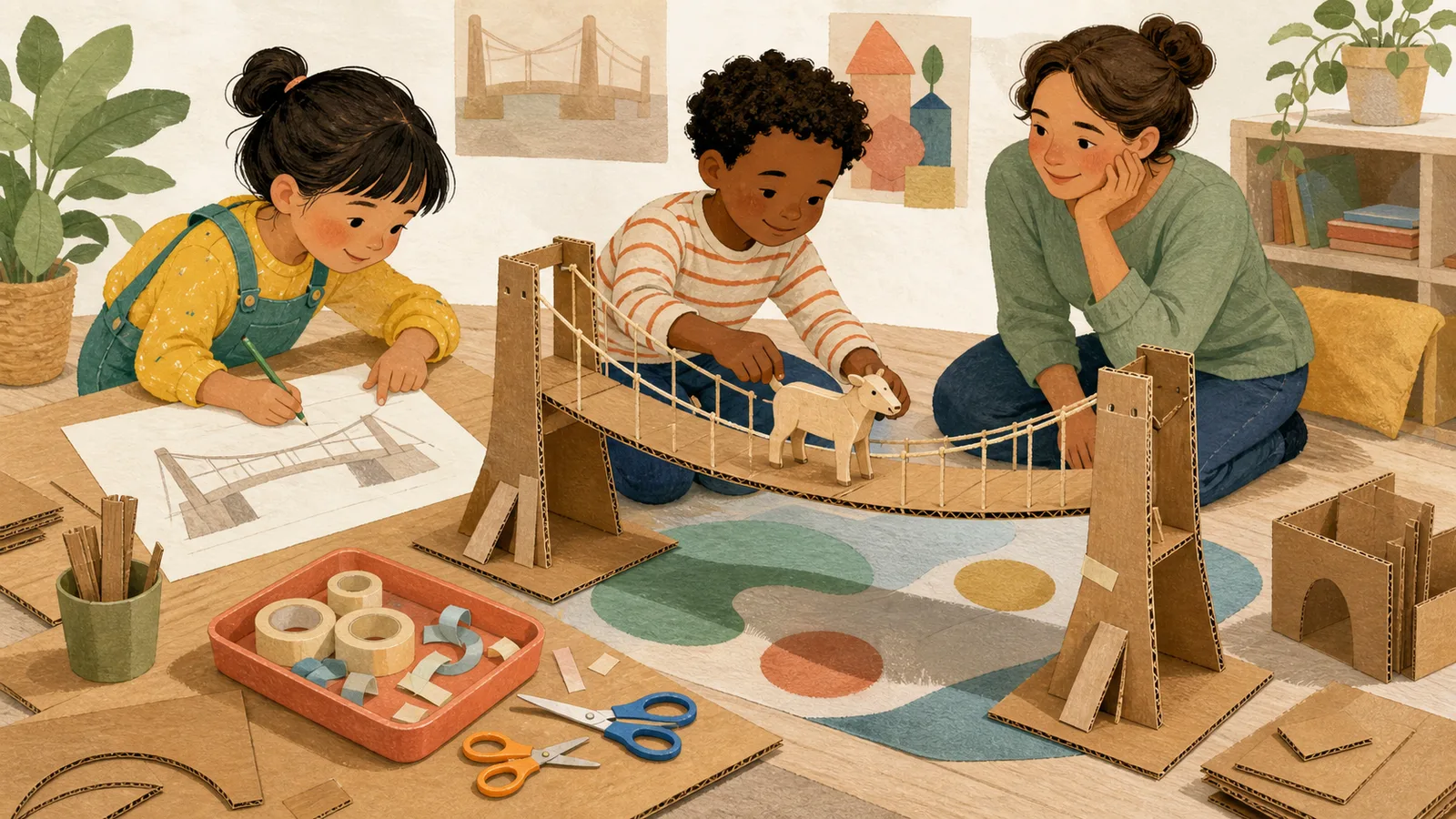
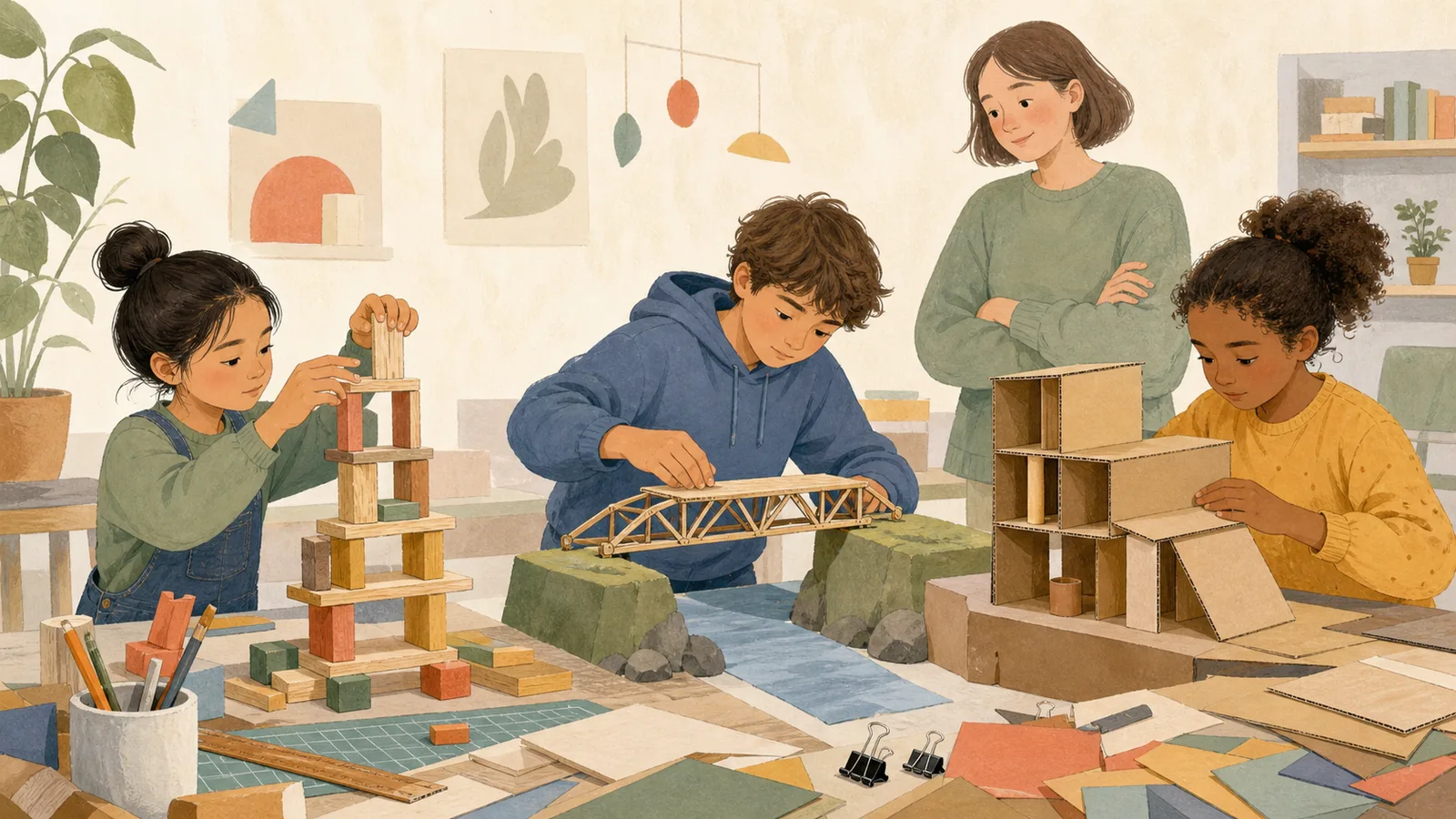
The same problem—a bridge across a gap—can work from toddlerhood through age eight and beyond. Change the material, gap, load, joining method, and amount of documentation. The problem stays recognizable while the thinking becomes more complex.
Six levers that change difficulty
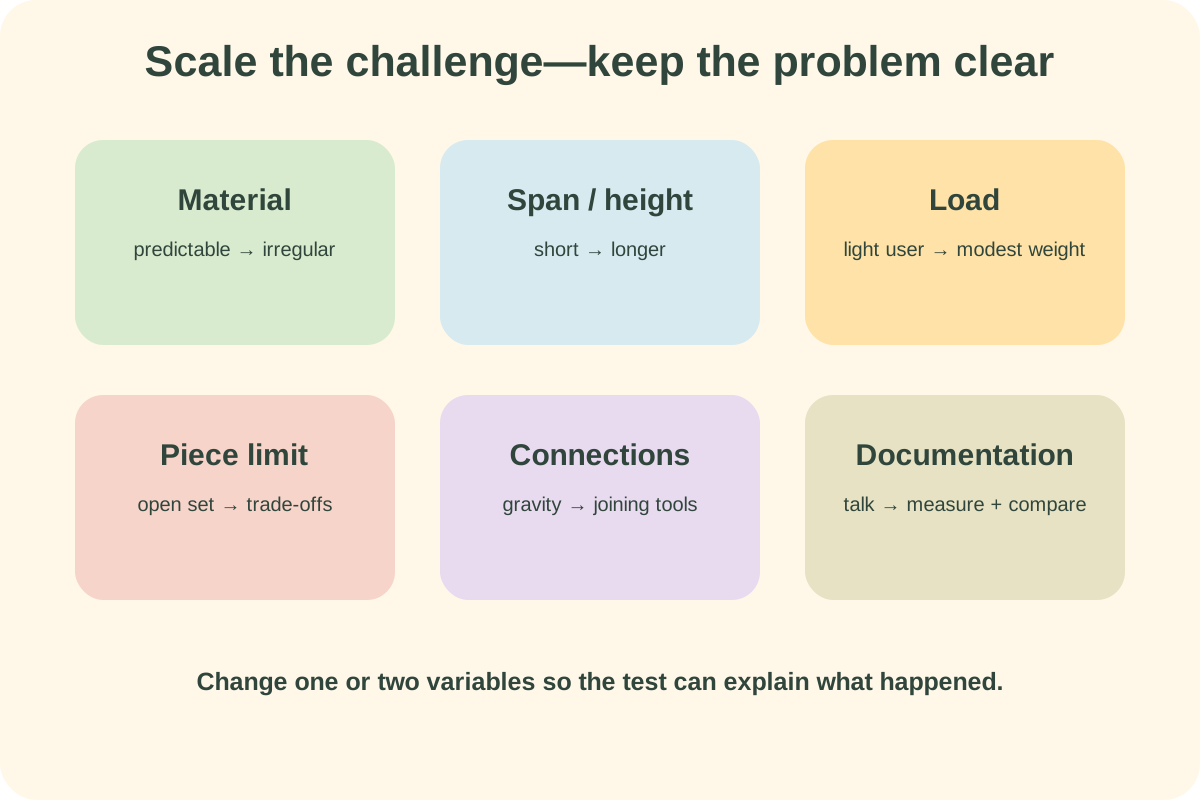
- Material predictability: large blocks are easier to balance than bendable paper or irregular natural pieces.
- Distance or height: a longer span and taller structure create new forces and alignment demands.
- Load: one light figure differs from several books; keep loads safe and modest.
- Piece limit: fewer pieces force trade-offs but can also create artificial frustration.
- Joining method: gravity-only, slots, clips, tape, and fasteners require different control.
- Documentation: talking, sketching, measuring, photographing, and recording tests add planning demands.
Change one or two levers. If every condition changes at once, neither child nor adult can tell why the design behaved differently.
Ages 1–2: action before a formal challenge
Offer a few large, age-suitable blocks and an immediate relationship.
- Place one block on another.
- Roll a cylinder toward a broad stop.
- Put a large figure inside a three-block boundary.
- Knock down a short adult-built tower in a clear area.
The adult’s job is to keep pieces manageable and describe what happened: “It stayed,” “It rolled,” “The animal is inside.” A toddler does not need a drawing, timer, or requirement to redesign.
Our first-block guide covers scale, weight, and material for this stage.
Ages 2–3: one visible problem
Choose a goal that the materials nearly solve:
- make a road to the basket;
- build a bed long enough for one animal;
- span a very short gap with one long block;
- make a wall that stands while a vehicle passes beside it.
Keep constraints conversational. “The animal needs to fit” is enough. If the child changes the story instead—perhaps the animal sleeps on the roof—that is a valid play decision, not failure to follow the assignment.
Ages 3–4: compare two arrangements
Preschoolers may enjoy testing alternatives:
- Which base lets the same tower stand?
- Can a bridge use two supports, then three?
- Which ramp position makes a large ball stop near the line?
- Can a shelter have an entrance and a roof?
Use one consistent test and invite a change. Avoid declaring a universal engineering principle from one playful trial. The surface, material, and adult setup all affect the result.
Ages 5–7: constraints and intentional revision
Children can often hold several conditions in mind:
- bridge a 30-centimeter gap and hold one paperback;
- build a freestanding tower using no more than 20 blocks;
- make a marble-free ball run with two direction changes;
- create a cardboard shelter with a removable roof;
- design a paper structure that supports a small toy.
Let them choose the design. A sample image can become the answer key, so show material techniques—fold, roll, brace, slot—rather than a final object.
The cardboard engineering guide provides safer tool roles and six complete challenges.
Age 8+: trade-offs, data, and users
Older children can define criteria and compare more than one successful solution:
- maximize span while limiting material mass;
- design a bridge for two different users, such as a wheeled toy and an animal;
- compare two truss patterns using the same card strips;
- build a structure that packs flat and reassembles;
- create a game another person can learn without verbal coaching;
- redesign an existing object for easier storage or access.
Add measurement only when it answers the question. Record span, load, number of pieces, or setup time. Do not bury the design in a worksheet.
Older children can use more capable tools after instruction and supervision, but age alone does not grant readiness. Adults retain high-risk cutting, drilling, hot glue, and power tools unless a structured workshop and protective controls say otherwise.
One mixed-age bridge project
Set two supports and a shared crossing problem.
- Toddler: carries large blocks and makes a road toward the gap.
- Preschooler: experiments with supports and a short span.
- Ages 5–7: builds and tests a deck using agreed materials.
- Age 8+: measures the span, documents revisions, or designs a railing without taking over the deck.
Give each child ownership of a part. “Everyone build the same bridge” creates comparison; parallel responsibilities create collaboration.
All shared floor materials must suit the youngest child with access. Older-age tools and connectors stay at a separate workstation.
Tests that reveal useful information
Good tests are repeatable enough to compare and gentle enough to preserve safety:
- same object crossing the bridge;
- same paper fan at the same distance from a tower;
- same ball released from the same ramp mark;
- same small book placed at the center of two structures;
- same assembly attempted by a new user.
Do not let children climb, hang from, sit on, or stand under homemade structures. A cardboard or block build is not load-rated furniture.
Timers and competitions
A timer can create an interesting constraint for a child who enjoys speed, but it often shifts attention from design to frantic assembly. Strength contests also favor the child with more material, prior experience, or adult intervention.
Prefer a private design question: “Can your next version use two fewer pieces while keeping the same span?” Compare a child’s design with their earlier version, not with a sibling’s.
When to help
Help when safety, tool control, access, or a mechanical barrier prevents the child from working on the intended problem. Hold a joint, cut a requested opening, or restate the constraint.
Wait when the structure wobbles, the child is studying it, or a first idea fails safely. NAEYC engineering resources emphasize iteration; adult rescue can erase the information a test just provided.
If frustration rises, reduce one lever: shorten the span, add a predictable connector, remove the piece limit, or return to tinkering. A child may also stop. Voluntary engagement remains part of play.
Frequently asked questions
What is the best building challenge for a seven-year-old?
A bridge, ramp, shelter, tower, package, or game can all work. Choose a real user or test and two manageable constraints. Match tools to demonstrated control.
Do building challenges teach engineering?
They can provide experience defining problems, comparing material behavior, testing, and revising. That is an age-appropriate encounter with engineering practices, not professional training or proof of future achievement.
Should every build have a plan?
No. Tinkering and free construction develop material knowledge that later planning depends on. A spoken idea, rough sketch, or first prototype can each serve as a plan.
How do I challenge a child who already builds complex structures?
Change the user, constraint, or evaluation. Ask for portability, accessibility, repairability, lower material use, or a second design with different trade-offs rather than only greater height.
What if my child never wants to rebuild?
Notice the result once and leave the option open. Revision is valuable when the child owns a reason to improve. Forced rebuilding turns feedback into correction.
Sources and research note
Continue with cardboard engineering challenges or add precise adult language from spatial language in block play.
The challenge ladder is an editorial synthesis of NAEYC resources on design challenges, authentic building problems, and inclusive engineering design, plus family engineering materials from the Museum of Science. Research on guided play and block interventions informs the evidence context, but no study validates these age bands as fixed stages.