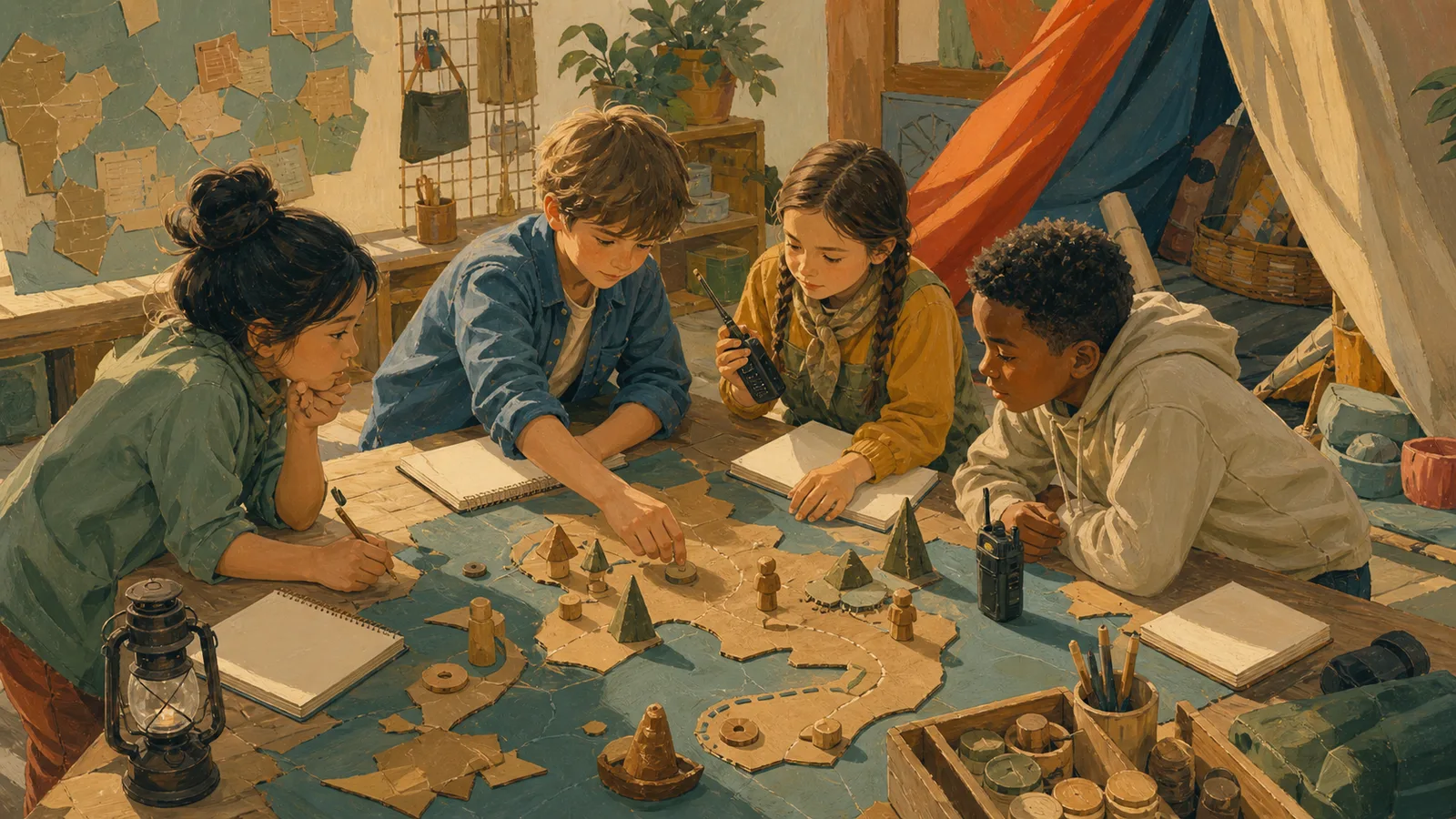
An eight-year-old may reject a costume rack and still spend an afternoon designing an expedition, voicing characters, building a headquarters, or negotiating rules for an invented society. Imaginative play has not necessarily disappeared. It may be less visible, more planned, and more sensitive to adult attention.
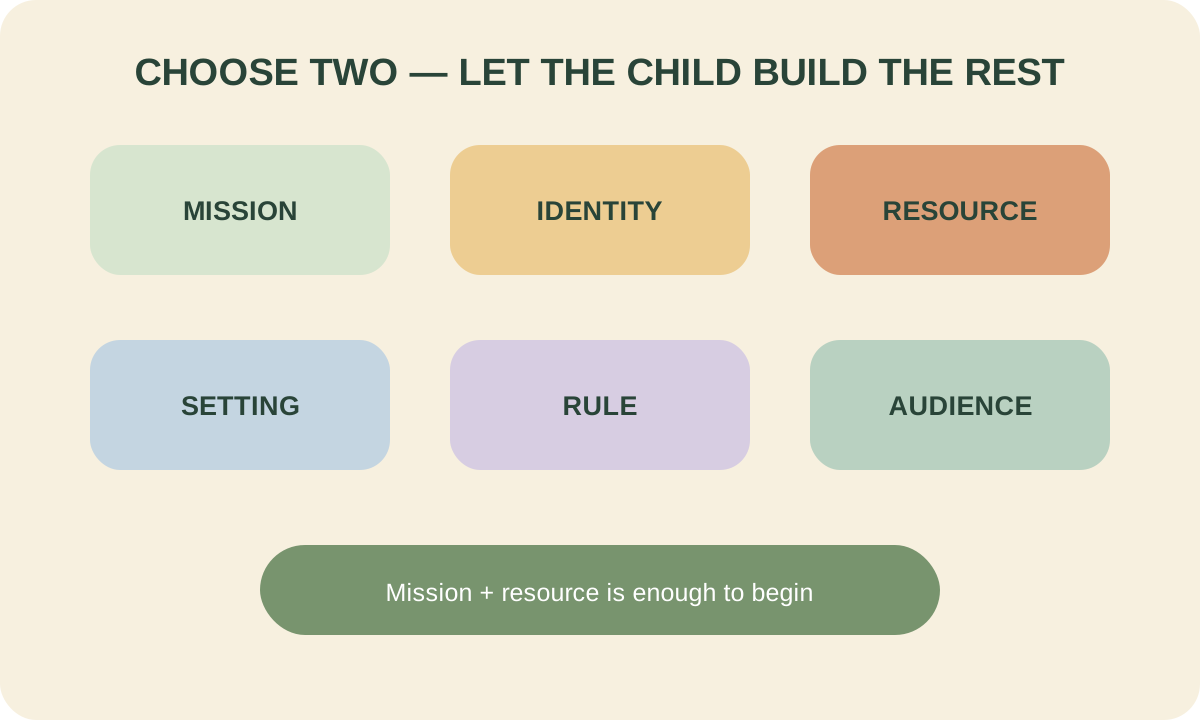
Offer a framework, not a preschool corner
Choose two elements and let the child supply the rest:
- Mission: recover, investigate, deliver, document, protect, negotiate.
- Identity: engineer, archivist, ranger, broadcaster, navigator, designer.
- Resource: six tokens, one vehicle, limited tape, three messages.
- Setting: remote station, future town, hidden museum, storm shelter.
- Rule: no one can cross the floor, all news must be verified, structures must pack flat.
- Audience: another team, a stuffed-animal council, future visitors, nobody at all.
“You have a field station and a damaged bridge” leaves more room than a complete expedition script.
Eight ideas that do not feel babyish
1. Field expedition
Choose a room or yard as unfamiliar terrain. Roles might include navigator, specimen illustrator, quartermaster, and communications lead. Use ordinary notebooks, cardboard viewers, fabric packs, and age-appropriate real measuring tools under suitable supervision.
2. Museum after hours
Children select objects, invent provenance, design security, create an audio tour, or investigate why an exhibit moved. Writing is one possible medium, not a requirement.
3. Emergency logistics center
A fictional storm has blocked routes. The team must move supplies with a limited number of vehicles or containers. Keep disasters abstract if real events are distressing.
4. Broadcast studio
Create weather, sport, interviews, comedy, or news from an invented place. Recording is optional and requires everyone’s consent; live performance for adults is not the price of playing.
5. Design commission
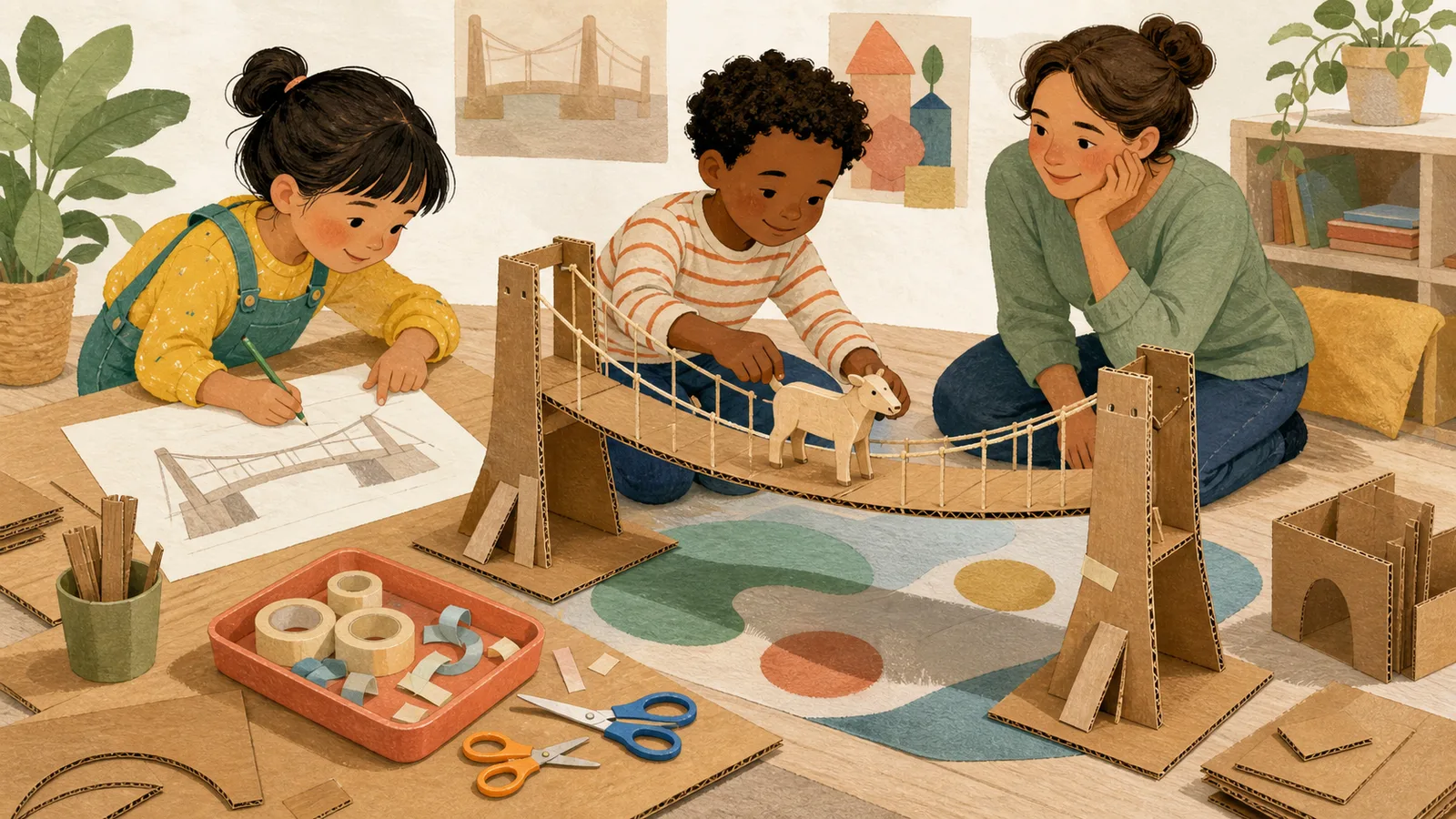
A client needs a portable shelter, celebration space, animal crossing, or stage. Pair role play with a cardboard engineering challenge and let the “client” revise requirements.
6. Mystery archive
Use copies of invented symbols, safe objects, and conflicting clues. The mystery should be solvable in several ways. Avoid creating fear through realistic threats or secretly monitoring players.
7. Tiny civilization
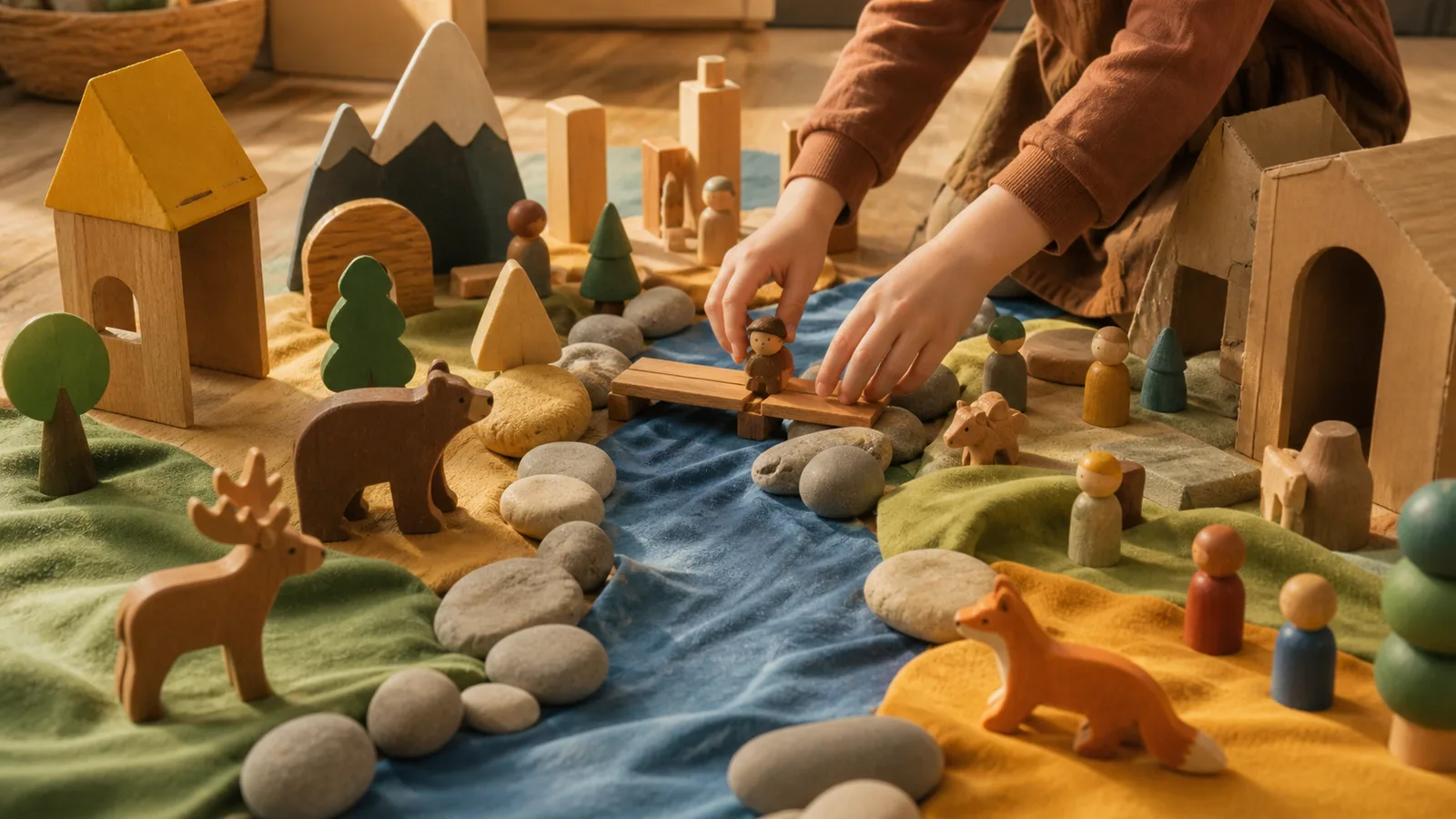
Figures need water, transport, rules, gathering space, and a way to resolve a disagreement. The small-world play guide helps with scale and storage, while older children can add history and systems.
8. Tabletop game prototype
Children invent roles, a shared objective, obstacles, and a way to resolve uncertainty with cards, tokens, or dice. The first round is a test, not a finished product. Changing a confusing rule is part of design.
Solo and quiet forms count
Role play does not need loud voices or a group. A child may write logs from a character’s viewpoint, build rooms for unseen inhabitants, draw costume designs, organize an archive, or move figures privately. Do not demand a performance or ask them to explain every symbol.
A quiet invitation can be one envelope containing three blank cards and a token. “This was found outside the station” is enough. If nothing happens, pack it away without turning the offer into a judgment.
Joining without taking over
Ask what kind of participant is welcome: character, audience, resource provider, or not involved. If assigned exact dialogue, negotiate: “I can follow the mission, but I want to choose this character’s words.”
Adults can protect logistical boundaries—where tape may go, when the room must reset, whether recording is allowed—without controlling fictional outcomes. Set the end time early enough that the group can preserve notes or photograph a build.
For children still enjoying costumes, the open-ended prop collection scales better than character-specific outfits. Neutral bags, cloth, boxes, and role markers remain useful in older missions.
Mixed-age siblings
Give roles with different kinds of power. An older child can manage the map while a younger child transports large safe parcels; then swap which decisions matter. Do not make the older child responsible for preventing a toddler from accessing miniatures. Physically separate unsafe components.
A shared build can use large blocks for everyone and add older-child documents at a high table. If the younger child repeatedly disrupts a carefully planned world, schedule protected time rather than expecting endless inclusion.
What changes with age—and what the evidence cannot settle
Research and theory have historically focused on early childhood pretense. Older symbolic activity can move into drama, narrative, games, model worlds, art, and construction, making it harder to observe with preschool measures. That is one reason a simple “children stop pretending at age X” claim is not defensible.
Studies link pretend play with various developmental outcomes, but a broad evidence review found that pretending has not been established as their unique cause. Offer role play because it is engaging and expressive. It does not need an academic sales pitch.
When not to push
Some children prefer factual projects, sport, craft, reading, collecting, coding, conversation, or outdoor activity. A lack of enthusiasm for adult-proposed role play is not a problem to correct. Avoid teasing, filming without consent, or displaying private story materials.
If you have broader developmental or wellbeing concerns, discuss concrete observations with an appropriate professional rather than using interest in fantasy as a stand-alone measure.
Frequently asked questions
Is pretend play normal for a ten-year-old?
Yes. It may appear as worldbuilding, role-playing games, performance, writing, construction, or private stories. Interests and visibility vary widely.
What if my child says pretend play is for babies?
Accept the label and offer a design challenge, mission, game prototype, studio, or investigation without calling it pretend. Or offer a different kind of activity entirely.
Do I need to buy a tabletop role-playing game?
No. A shared mission, roles, a few resources, and an agreed way to handle uncertainty are enough. Published games can help families who want structured rules but are optional.
How do I set a limit when the game takes over the house?
Agree on zones, materials, and reset time before setup. Provide one save surface for a continuing build and require pathways and exits to remain clear.
Sources and research note
This article uses a lifespan discussion of where pretend play goes, reviews of developmental claims and pretend-play measurement, and a recent social-competence meta-analysis. Broader play context comes from the AAP clinical report The Power of Play and NAEYC’s developmentally appropriate practice principles.