
A board game does not teach because its box shows equations, maps, or vocabulary. It offers practice through repeated decisions: count spaces, estimate risk, remember hidden information, negotiate, inhibit a tempting move, plan resources, or explain a clue.
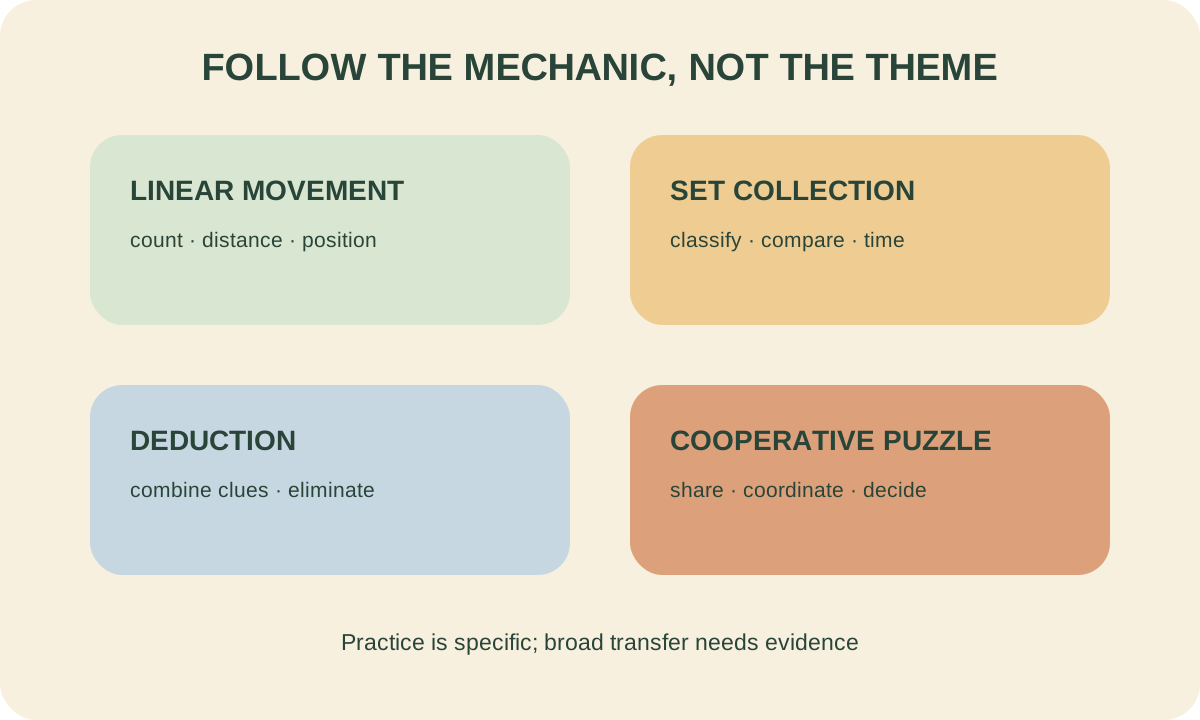
Read the mechanic before the theme
| Mechanic | What players repeatedly do | Selection question |
|---|---|---|
| linear movement | connect number, count, distance, position | is counting embedded in every turn? |
| set collection | classify, compare value, plan timing | can a new player see useful options? |
| memory reveal | hold and update locations | does memory decide everything? |
| resource allocation | trade immediate and later value | are consequences understandable? |
| deduction | combine clues, eliminate possibilities | is reading load separate from reasoning? |
| cooperative puzzle | share information and coordinate | can one player dominate decisions? |
| dexterity | control force, speed, or balance | is motor skill overshadowing strategy? |
Themes matter for interest, but a space-themed roll-and-move game may offer less scientific reasoning than an abstract balancing game. Ask what happens on an ordinary turn.
What board-game research can support
Systematic reviews report benefits in some educational and cognitive interventions. Early number-board games have a particularly studied mechanism: linear spatial movement paired with number language. Other research includes games designed by educators or clinicians for specific outcomes.
Important cautions remain:
- studies use different games, ages, session counts, comparison groups, and measures;
- near improvement on a practiced task is not broad transfer;
- a researcher-guided intervention differs from a box used occasionally at home;
- publication quality and sample size vary; and
- long-term effects are less certain.
It is reasonable to say games can provide structured practice and some interventions improve measured outcomes. It is not reasonable to claim any strategy game raises intelligence or executive function.
Choose for actual family fit
Reading load
Can important cards be understood without an adult translating every turn? Icons help only when they are consistent and legible. If reading is the barrier, read cards aloud for everyone rather than secretly coaching one player.
Decision load
More options are not automatically better. A child who can plan one turn ahead may stall when asked to evaluate ten cards, four resources, and opponents’ hidden goals.
Downtime
Long turns make waiting harder. Look for simultaneous choice, reactions, or short turns if attention fades between actions.
Elimination
A player removed early must watch rather than play. For families still learning to lose and recover, avoid elimination or add a quick re-entry rule that does not distort the central decisions.
Session and setup
The published play time often excludes teaching, sorting, and interruptions. A 30-minute game can require 15 minutes of setup. Store frequently used components in labeled bags and choose a smaller scenario on weeknights.
Emotional stakes
Observe how much randomness, attack, secrecy, bluffing, and direct theft a child enjoys. “Age 8+” is a safety and complexity signal, not a guarantee of emotional fit.
Teach in layers
- State the shared objective or win condition.
- Show the turn with visible components.
- Play two open practice turns with hands revealed.
- Add exceptions only when they arise.
- Stop early if the first session has served its purpose.
Do not front-load every edge case. If strategy advice becomes constant, adults are playing through the child. Ask whether they want one suggestion.
Should adults let children win?
Secretly changing outcomes can make the game incoherent. Instead choose a game with manageable uncertainty, teach openly, use a handicap everyone knows, or play cooperatively. Model losing without drama and winning without gloating.
For a child who needs more control, let them run a practice round or design a variant. Our older-kids role-play guide includes game prototyping as imaginative design rather than a fixed contest.
Cooperative is not automatically gentler
Cooperative games can reduce direct winning and losing, but they may invite “quarterbacking,” where one experienced player makes every decision. Give each player private information, rotate facilitator roles, or require advice to be offered rather than imposed.
Competitive games can support respectful comparison and recovery when stakes and session length fit the group. The category does not determine the quality of interaction.
Adapt access, preserve decisions
- Use a card holder or larger print for visual/motor access.
- Replace color-only information with shapes or labels.
- Remove a memory burden if deduction is the main mechanic.
- Shorten the target score instead of taking turns for the child.
- Pair players temporarily, with the child choosing the final action.
- Use open hands while learning, then add hidden information later.
An adaptation is successful when it removes an irrelevant barrier without eliminating all meaningful choice.
Buying without the curriculum pitch
Read the rulebook or watch an official rules explanation before purchase. Inventory the table space, player count at which the game actually works, component size, and likely setup. For broad educational labels, use our claim-audit guide.
One game played repeatedly and enjoyed will provide more practice than five “learning games” avoided after the first lesson.
Frequently asked questions
Do board games improve math?
Some number-board and educational-game interventions improve measured math outcomes. That finding does not apply equally to every game, age, or kind of math.
Do strategy games improve executive function?
They require planning, inhibition, working memory, or flexibility to varying degrees. Evidence of broad transferable improvement is mixed and intervention-specific.
What if my child changes the rules?
Decide whether you are testing the published game or designing a new one. Both are valid activities. Write the variant clearly and compare how it changes decisions.
Is a longer, harder game more educational?
No. Complexity can create richer decisions or simply more bookkeeping and adult help. Choose the smallest rule set that sustains interesting choices.
Sources and research note
For gift selection, apply the challenge and partner checks in gift ideas for ages five to seven; children who prefer inventing rules can try older-kid role-play design.
Evidence was synthesized from the systematic review The Effectiveness of Intervention With Board Games, a review of board games and school learning, a review of board games and early mathematics, and an NSF-hosted review of learning games in K–12 mathematics. Broader executive-function claims were checked against a systematic review of preschool interventions. LWT did not hands-on test or rank commercial games.