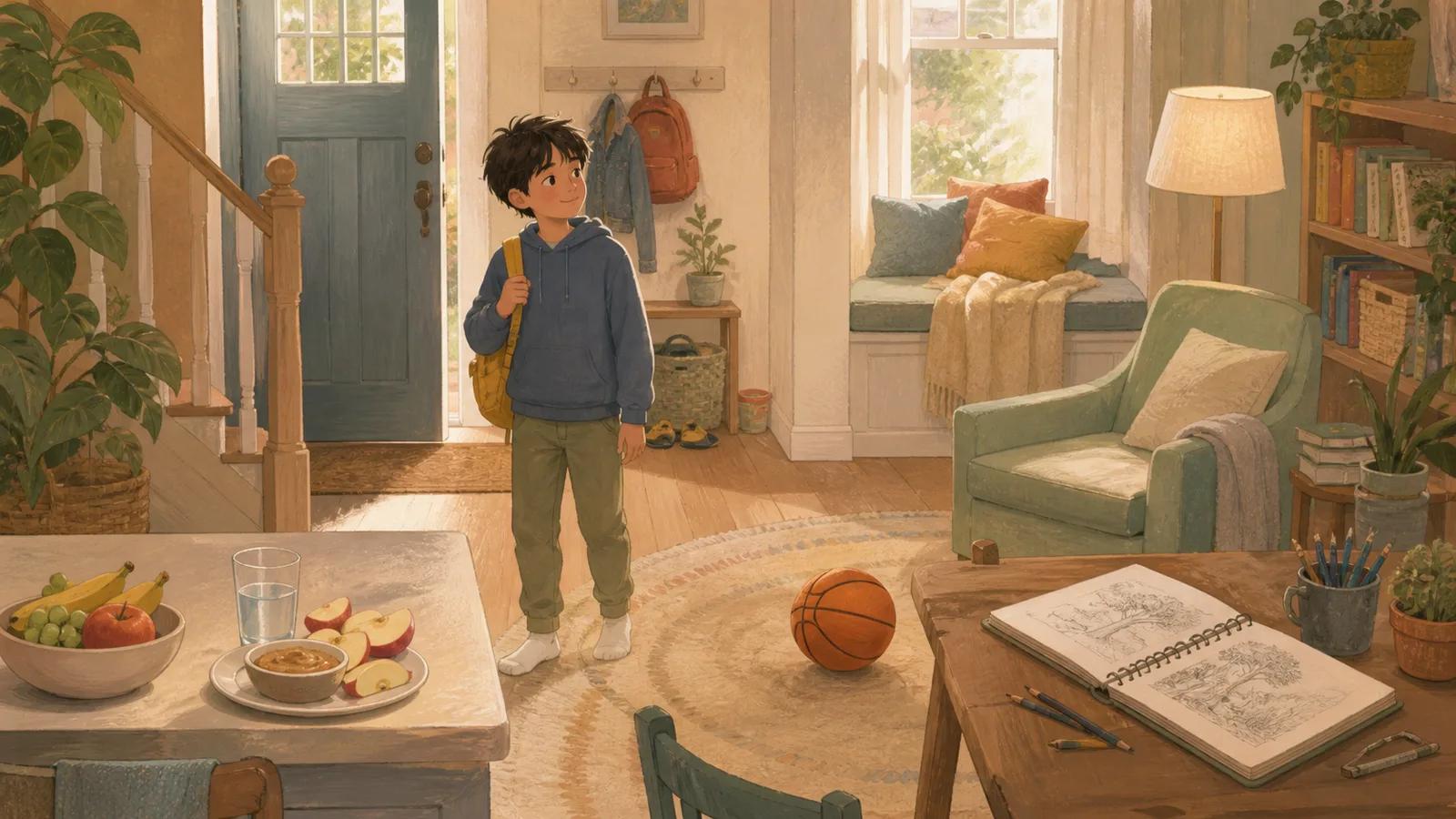
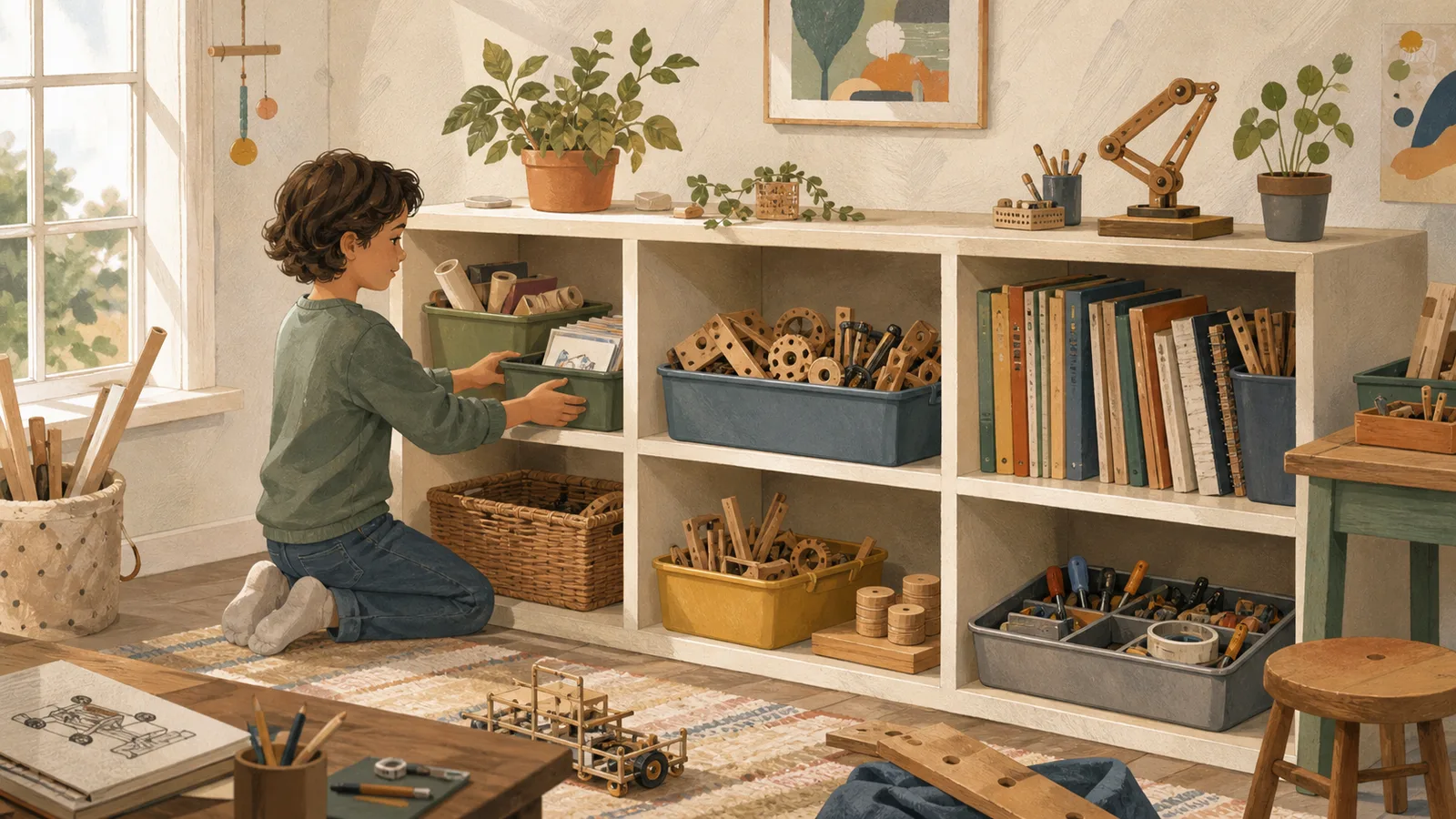
An older child may be finished with the word “toy” while still playing constantly: drawing comics, building a game, practicing tricks, collecting facts, staging videos, cooking, coding, reading or negotiating a shared world with friends.
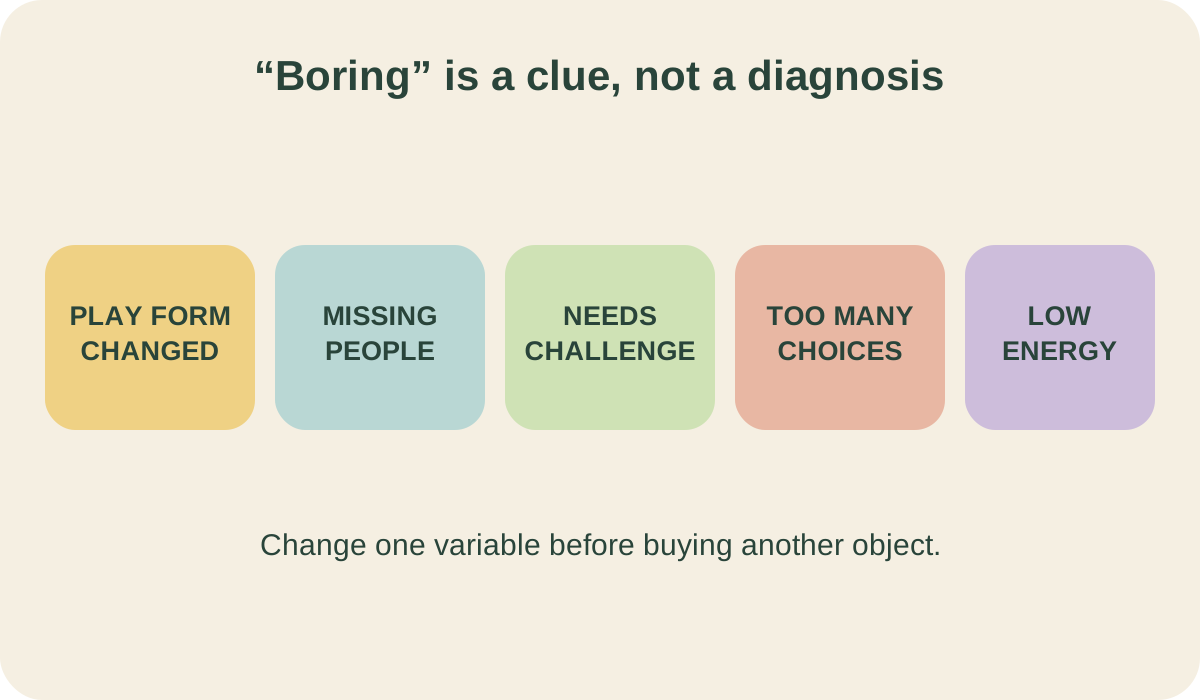
First, translate “boring”
Ask one concrete question: “Is it too easy, too hard, lonely, or just not what you want right now?” The answer can be “I don’t know.” Observe rather than cross-examine.
The play form changed
Move from objects to projects. A bin of bricks may become architectural drawing, stop-motion scenery or a load-bearing test. Figures may become a tabletop campaign or costume design. Use our older-child role-play ideas when pretending has become world-building.
The missing material is another person
Some games need peers, an adult opponent or an audience. Offer a defined 15-minute entry, arrange a friend where feasible, or select a solo form without implying that social play is dependence.
The challenge is wrong
Add one authentic constraint: build within a footprint, create a game someone else can learn, repair a broken mechanism, compose with three sounds, or cook within a budget. Avoid turning free time into a worksheet.
Choice is overwhelming
Put most materials away with the child’s involvement and make three active invitations visible. The toy rotation guide can be adapted for older children, but their ownership and access deserve more say.
Energy is depleted
After school, illness or a packed week, the child may need food, quiet or co-regulation before initiative. Use the after-school needs menu rather than presenting ten ideas at once.
Run a one-variable experiment
Keep the materials and change one condition for a week:
| If you suspect | Change | Observe |
|---|---|---|
| Too easy | Add a real constraint or audience | Does planning deepen? |
| Too hard | Provide a first step or partial setup | Can the child continue? |
| Lonely | Schedule a partner or parallel adult | Does engagement return? |
| Overwhelming | Display three options | Is starting easier? |
| No ownership | Let child relocate or redesign the space | Do they maintain it? |
| Low energy | Move play to a rested window | Was timing the issue? |
Do not run all six at once. The point is learning, not proving the child should enjoy old toys.
Build an older-kid play shelf
Organize by verbs rather than age labels:
- make: paper, tape, drawing and textile tools;
- build: compatible construction and safe hardware under appropriate control;
- investigate: magnifier, field notebook, reference books;
- perform: music, props, recording plan with privacy rules;
- play together: two or three games with known partners and realistic durations;
- continue: one tray for an ongoing project.
Remove broken, incomplete and humiliatingly young-marketed packaging while keeping beloved objects if the child wants them. Do not force donation as proof of maturity.
Boredom is not a guaranteed creativity treatment
Popular advice often says children “need to be bored” because boredom causes imagination. A 2024 scoping review of boredom and creativity in educational contexts found evidence in both directions and did not support a clear causal effect. Boredom can be a neutral transition, an unpleasant state, or a signal; it is not a developmental intervention by itself.
Adults do not need to eliminate every pause. They also do not need to withhold connection or meaningful materials to manufacture boredom. The aim is a workable balance between support and child agency. Our independence-through-play guide addresses that gradual handoff.
Before buying something new
Borrow, rent, visit a library/maker space, try a friend’s game, or buy one replacement component. Ask what the new item enables that current materials cannot. For tabletop gifts, the board-game learning guide helps match mechanics, reading and partner needs.
If the child requests a specialized tool, evaluate safety and access rather than dismissing it as “not a toy.” Older play often produces something.
When it may be more than play boredom
Seek individualized help when loss of interest extends across previously enjoyed activities, lasts, causes distress or impairment, or appears with major changes in sleep, appetite, school attendance, mood, relationships or safety. This article cannot diagnose depression, anxiety, ADHD, autism, learning differences or any other condition.
Sources and research note
Evidence caution centers on the 2024 scoping review of boredom and creativity, a systematic review of unstructured-play interventions, and a 2026 review of school-age free play and wellbeing. Broader play framing uses the AAP Power of Play report. The diagnostic table is editorial synthesis, not a medical diagnostic tool.