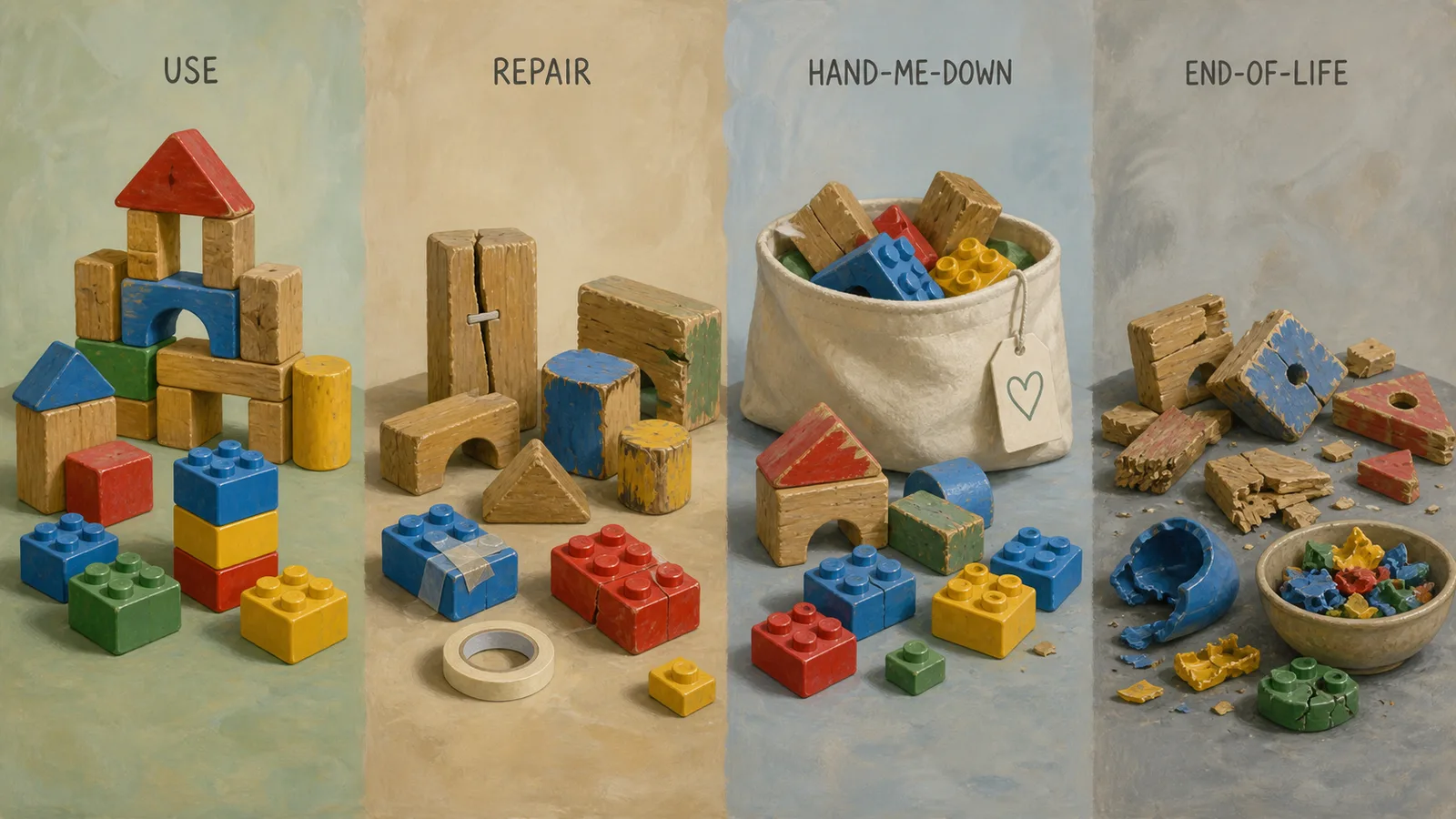
“Wood or plastic?” sounds like one decision, but each category contains excellent, poor and unsafe designs. Material matters; it simply does not answer the whole question.
Compare the actual toy
| Dimension | Wood may offer | Plastic may offer | What to verify |
|---|---|---|---|
| Weight | Stability and satisfying mass | Lighter handling and fewer impact concerns | Can the child lift or drop it safely? |
| Cleaning | Wipe-clean simplicity on sealed surfaces | Some designs tolerate washing or disassembly | Exact manufacturer method; hidden cavities |
| Durability | Solid parts can age well | Quality molded parts can survive hard use | Joints, stress points, thin walls, coatings |
| Repair | Sanding/refinishing may be possible for some adult-owned work | Replaceable modules exist in some products | Whether repair affects safety or warranty |
| Precision | Simple open-ended forms | Gears, snap fits and detailed shapes | Pinch points, breakage and age grading |
| End of life | Untreated single material may be simpler | Some polymers are recyclable in special streams | Mixed materials and local acceptance |
The table says “may” because a plywood toy with plastic film, metal axles and synthetic glue is not a single material. Nor is an electronic plastic toy with a circuit board, speaker and battery.
Safety is designed, not grown
Wood can splinter, crack, harbor moisture or deliver a harder impact because of its mass. Painted or coated wood needs a compliant finish. Plastic can crack into sharp edges, deform with heat or expose internal parts. Both can contain small parts, cords, magnets or inaccessible dirt.
Look for an identifiable manufacturer, age grading, warnings, secure construction and instructions. In the United States, toys intended for children must meet applicable CPSC requirements; a “natural,” “Montessori,” “eco” or “BPA-free” claim does not replace compliance.
For toddler-specific examples, our wooden-toy guide evaluates play value and trade-offs rather than treating wood as a virtue by itself.
Sustainability needs a life-cycle boundary
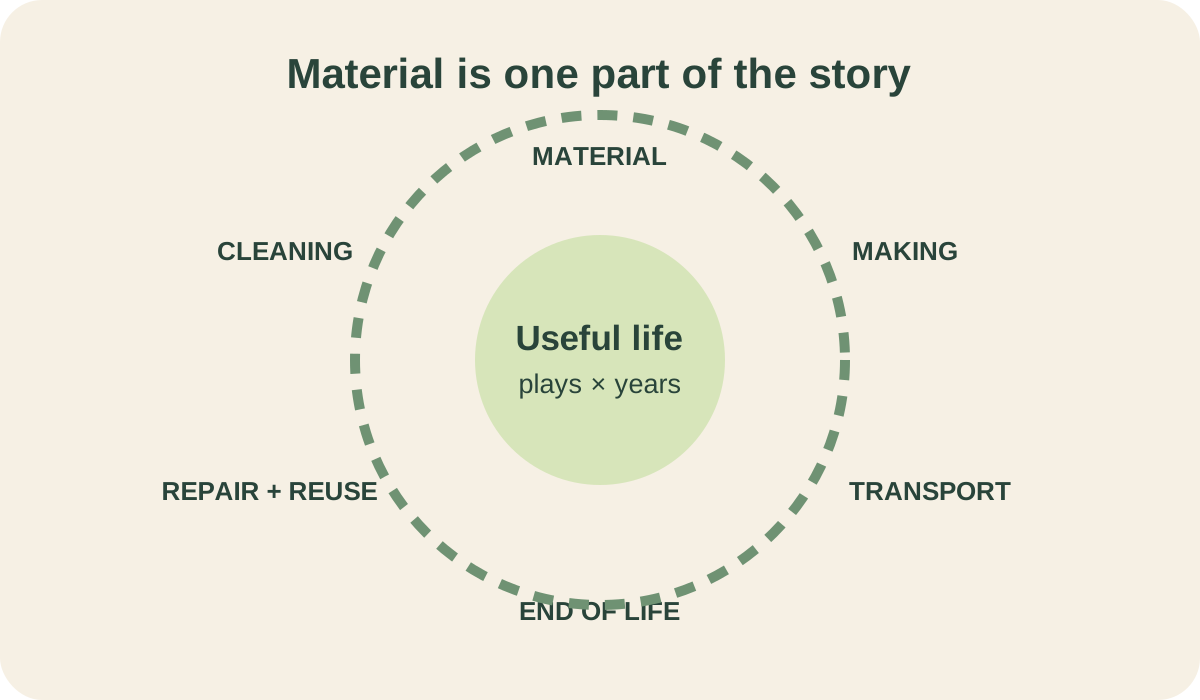
Life-cycle assessments consider raw materials, manufacturing, packaging, transport, use and end of life. Research comparing toys shows that outcomes change with product type and assumptions. There is no defensible universal statement that every wooden toy has a smaller footprint than every plastic one.
A heavy wood product shipped far may use more transport energy. A thin plastic novelty that breaks quickly may have little useful life. A durable plastic construction system used by siblings for fifteen years can perform differently per play session than a beautiful wood toy left untouched.
Ask:
- Will this specific child use it in more than one way?
- Does it fit the home, storage and cleanup routine?
- Can parts be replaced?
- Can it be cleaned without degrading?
- Is there a realistic second user?
- What facilities accept it at end of life?
The FTC’s Green Guides caution marketers against broad, unqualified environmental claims. Treat “eco-friendly” as a question prompt, not a conclusion.
Cleaning and hygiene
Plastic is often easier to wipe or wash, but holes and seams can trap water. Some plastics and electronics must not be submerged. Wood responds differently depending on species, finish and construction; soaking can cause swelling, checking and glue failure.
Follow the product’s instructions. A toy that requires a cleaning routine the household cannot sustain is not a durable choice for that household.
Repair and reuse
Simple solid wood pieces can sometimes be refinished or have manufacturer parts replaced. That does not make every repair safe: cracks in load-bearing parts, loose magnets, battery compartments, ride-ons and recalled products call for retirement or official service. Use the toy repair triage before reaching for glue.
Plastic repair is constrained by polymer type, stress and adhesive compatibility. A surface bond may hide a sharp internal fracture. Conversely, a quality manufacturer may offer a precise replacement component that makes repair straightforward.
Before accepting either material secondhand, use the identity and recall checklist.
A calmer buying rule
Choose the least complicated safe toy that fits a real play need. Prefer clear specifications, sturdy construction, manageable storage and a plausible long life. Buy fewer things you can maintain rather than purchasing a material identity.
For gifts, packaging and environmental claims can overwhelm the decision. Our sustainable toy gift guide starts with use, longevity and recipient fit.
Sources and research note
Environmental context comes from a 2022 peer-reviewed life-cycle assessment of children’s toys, a DePaul comparative toy LCA, and research on circularity in toys. Safety framing uses CPSC toy business guidance. Environmental marketing caveats use the FTC Green Guides. These sources do not establish a universal material winner.