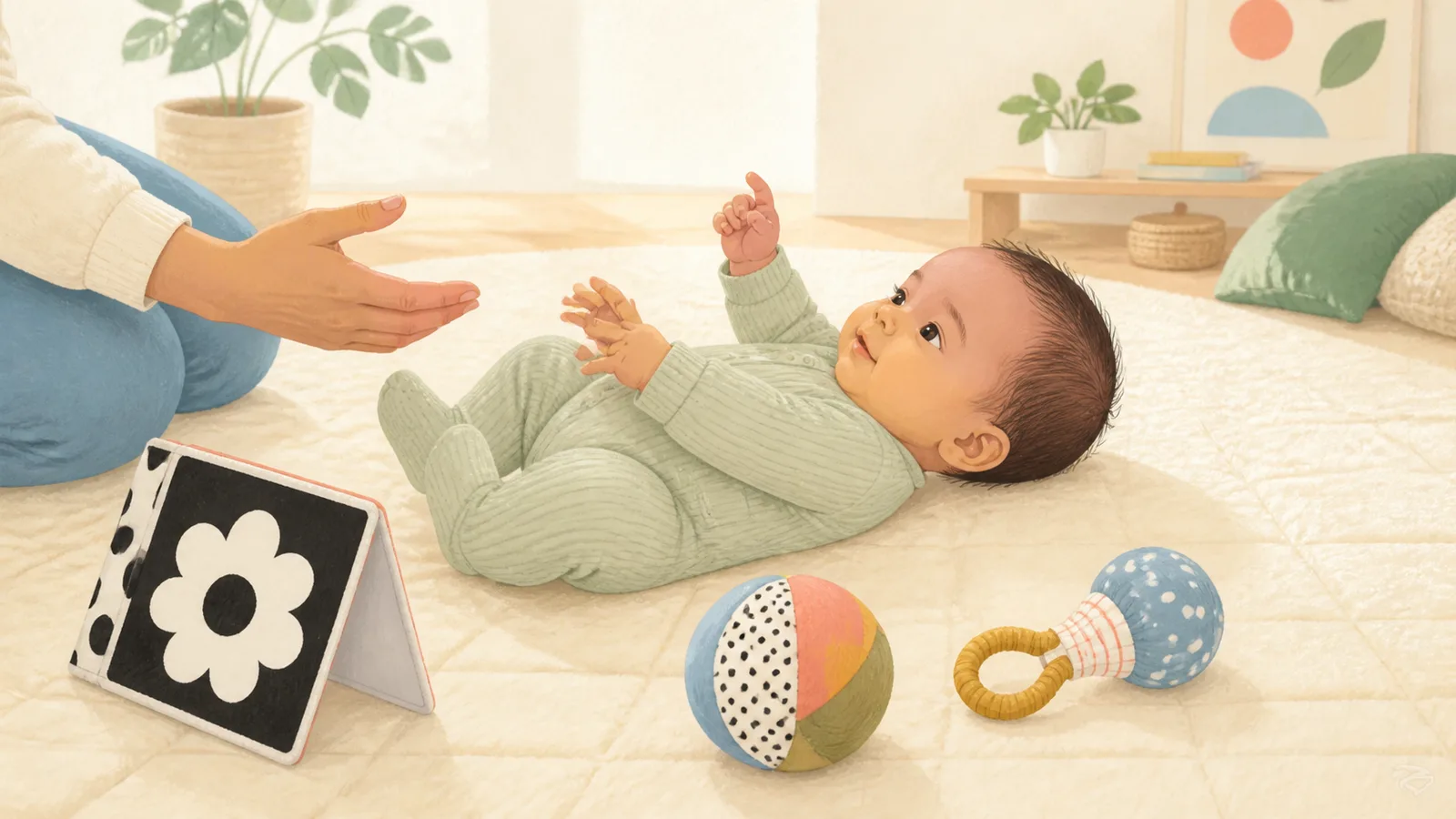
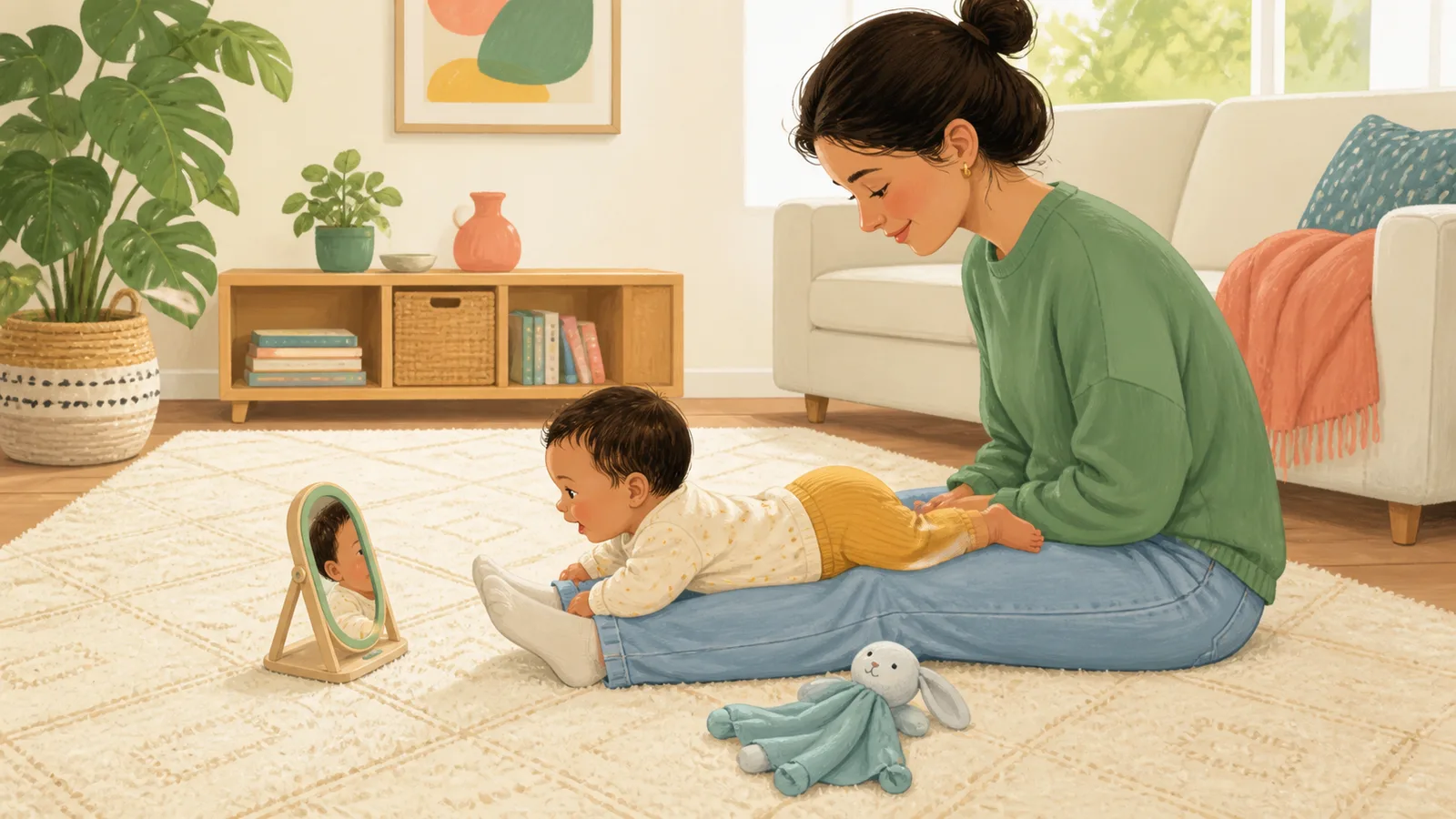
Tummy time does not have to begin as a long exercise on the floor. It can start with an awake newborn resting against a caregiver’s chest, progress to a supported position across a lap, and reach the floor in short attempts when both baby and adult are ready.
The non-negotiable boundary is simple: tummy time is for awake, directly supervised play. Babies should be placed on their backs for every sleep. If a baby falls asleep in a prone play position, move them to an appropriate firm, flat sleep surface on their back.
Quick answer for a baby who cries immediately
Pick a higher-contact position, try earlier in an alert period, and stop before distress escalates. Thirty calm seconds can be a useful beginning. Try again later rather than turning one attempt into a battle.
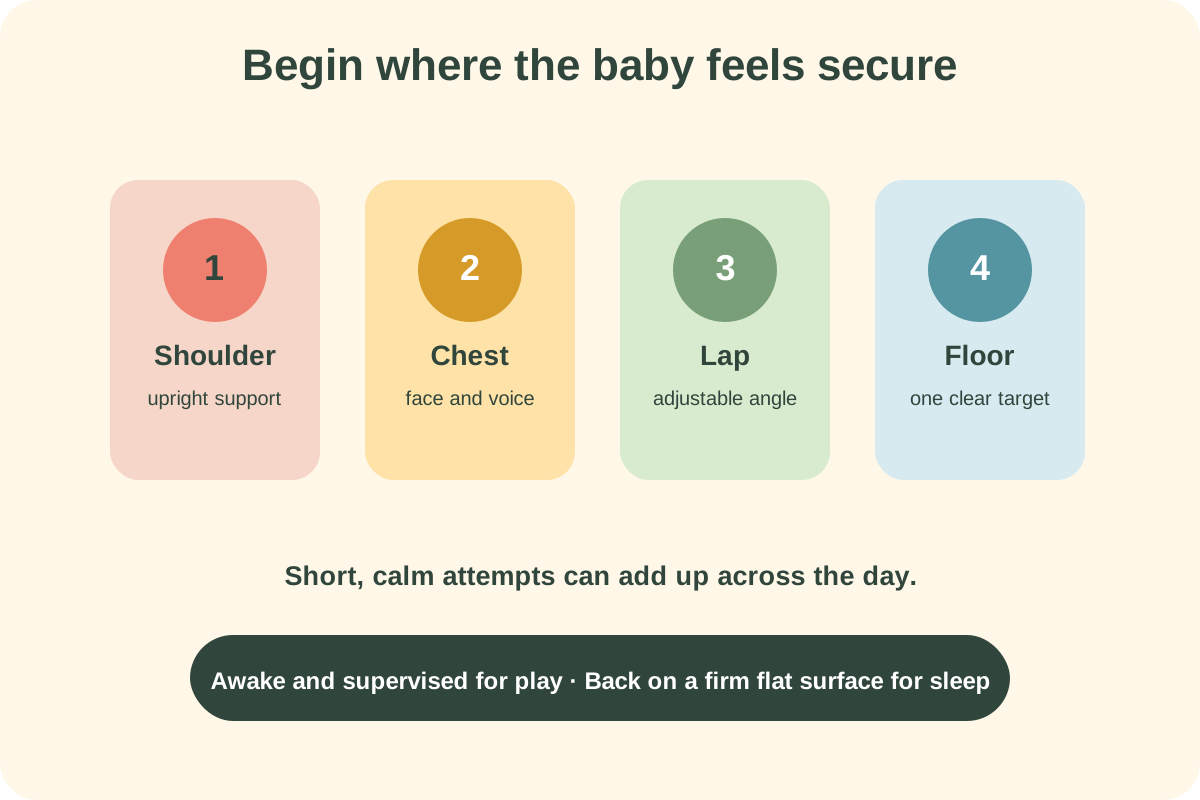
Use this order:
- upright against your shoulder;
- reclined chest-to-chest;
- prone across your lap;
- floor time with your face at eye level; and
- floor time with one simple visual or sound target.
Not every baby needs every step. The ladder is a way to reduce difficulty, not a developmental test.
Before you begin
Materials
- a clear, firm floor area or the caregiver’s stable lap or torso;
- one folded receiving blanket for comfort on a hard floor, if needed;
- one baby-safe mirror, contrast card, or soft toy; and
- an awake adult close enough to reposition the baby immediately.
A special mat, pillow, wedge, or activity gym is not required. Do not use sleep positioners as play equipment. If a clinician has given positioning instructions for a medical or developmental need, follow that individual plan rather than a general article.
Timing
Look for a quietly alert baby: eyes open, body relatively settled, and not urgently hungry. Immediately after a full feed may be uncomfortable for a baby who spits up. There is no universal waiting time that suits every feeding pattern, so use the baby’s history and advice from their health professional. If spit-up is forceful, green, bloody, painful, affects feeding or growth, or worries you, seek clinical advice rather than trying to solve it with a play position.
The room
Clear pets, older-sibling pieces, cords, hot drinks, and unstable objects from reach. Put your phone where you do not need to step away to answer it. Direct supervision means the adult remains awake, close, and focused on the baby.
The tummy-time position ladder
1. Upright against a shoulder
An upright cuddle lets a young baby work against gravity while supported. Hold the head and trunk as needed. This is not the same as floor tummy time, but it can be a useful entry point for a baby who dislikes a sudden change to prone.
Talk softly, turn so the baby can notice a light-dark boundary, or walk slowly through the room. The aim is comfortable head movement, not holding the head up for a performance.
2. Reclined chest-to-chest
Recline while fully awake and place the baby prone on your chest, supporting them securely. Your voice and face provide the invitation. The American Academy of Pediatrics includes tummy-to-tummy positioning as an early option, even before the umbilical cord has fallen off, provided the adult is awake and the position is controlled.
If you become drowsy, stop. A sofa or recliner is not a safe place to sleep with a baby.
3. Across the lap
Sit with both feet stable and lay the baby across your thighs, supporting the head and torso. A small change in the angle of your legs can make lifting easier or harder. This position suits adults who find getting down to the floor difficult.
Place a mirror on the floor in front of your legs, or ask another caregiver to sit where the baby can see a face. Keep a hand on the baby; your lap is not a surface from which they can safely be left unattended.
4. Floor, adult face first
Place the baby prone on a firm clear area and lie or sit down at eye level. Keep your face close enough to be easy to notice. Speak, imitate a sound, or slowly move from the center toward one side.
This often works better than placing several toys in a semicircle. One face gives the baby a clear reason to look without turning the setup into visual clutter.
5. Floor with one target
Add one unbreakable infant mirror, contrast card held by an adult, or soft sounding object. Place it within the baby’s comfortable visual range. Move slowly, then stop. A baby who lowers their head is not failing; they may be resting before another effort.
Seven low-pressure tummy-time play ideas
Mirror hello
Place a stable, baby-safe mirror on the floor. Let the reflection appear without repeatedly tapping the glass or moving the baby’s head. Describe what is happening in ordinary language: “You found a face.” The mirror is a visual target, not a lesson in self-recognition.
Slow-roll ball
Roll a light fabric ball slowly from one side of the baby’s view to the other. Stop at the center. Later, place it close enough for an accidental hand contact. Avoid small balls and hard balls that can roll into the face.
Caregiver switch
Have one caregiver provide secure positioning while another sits in view. A sibling can sing from beside the adult, provided they do not crowd, touch, or place toys near the baby without guidance. This makes the social part of the activity more interesting without adding equipment.
One-song attempt
Choose a short familiar verse. Begin the position, sing slowly, and finish or stop earlier if the baby becomes distressed. A song provides a predictable boundary; it is not a timer you must complete.
Window watch
Place the floor setup where indirect daylight creates gentle contrast, away from direct sun, drafts, blind cords, heaters, and unstable furniture. Let the baby notice moving leaves or changing light. The adult remains close and keeps the face out of harsh glare.
Texture under the hands
Put the baby on a familiar washable mat and place a different safe fabric under the forearms—not loose near the face. Notice whether the baby presses, opens a hand, or drags fingers. Stop if the fabric bunches or the baby mouths an edge that is not intended for infant use.
Reach from the side
For an older infant who already reaches, place one suitable object slightly to the side rather than directly ahead. This can invite weight shifting. Keep it close enough that the attempt is possible and never pull an arm into position.
Our broader guide to floor play before crawling includes back-lying, side-lying, and reaching games so prone time is not the baby’s only chance to move.
Troubleshooting the protest
“The baby cries before touching the floor”
Start one or two steps higher on the position ladder. Let the baby experience the room from your shoulder, then chest, then lap across several attempts. On the floor, place your face first and lower the baby toward you rather than setting them down and then walking around to the front.
“The head drops after a few seconds”
That can be fatigue. End or change position before the baby becomes overwhelmed. Head lifting develops through many ordinary movement opportunities, not one heroic session. Do not prop the chin or force the head to stay up.
“There is spit-up every time”
Try earlier before a feed, or after the baby has had time upright following a feed according to their usual care routine. Use chest or lap positioning if the angle is more comfortable. Normal spit-up can still be messy, so place a washable cloth under the adult’s control—never bunched around the baby’s face.
“The baby looks only one way”
Move your face or the visual target toward the less-used side without forcing the head. Alternate how you approach, feed, carry, and position during awake routines when practical. A strong or persistent preference, difficulty turning, head-shape concern, or visible discomfort should be raised with the baby’s clinician.
“Nothing distracts them”
Distraction may not be the right goal. The position may be difficult, the baby may be tired, or the attempt may simply be long enough. Reduce the challenge rather than adding louder and brighter toys. Our first-toy guide explains why one simple target is often sufficient.
How much tummy time is enough?
Health organizations encourage daily supervised prone play, but published minute targets vary and are often presented for different ages. Treat any target from your child’s clinician as a direction to build toward, not permission to ignore distress or a reason to compare babies.
Count the practical opportunities: chest time after waking, a short lap attempt, a floor song during a diaper-change window, and another floor attempt later. Repetition lets you observe what changed. It also reduces the pressure on one session.
Keep brief notes only if they help answer a real question, such as whether timing after feeds affects comfort or whether the baby always turns to one side. You do not need to log every second for routine play.
When rolling begins
Once a baby can roll into and out of positions, provide a clear floor area and let movement become more self-directed while you supervise. You do not need to repeatedly flip a content baby onto their stomach to “complete tummy time.” Continue offering floor play and place interesting objects where they can choose to reach or turn.
Safe sleep remains separate: place the baby on their back at the start of every sleep and follow current safe-sleep guidance for the sleep environment. Discuss individual questions about rolling and sleep with the child’s health professional.
When to ask for individual help
Bring concerns to a pediatric clinician or relevant therapist if the baby consistently seems in pain, cannot comfortably turn the head both ways, shows a strong persistent asymmetry, seems unusually stiff or floppy, uses one side very differently, has feeding or breathing concerns during positioning, or is not gaining skills in the way their clinical team expects.
Premature infants and babies with cardiac, respiratory, orthopedic, neurologic, feeding, or postoperative considerations may need an individualized position plan. General play ideas cannot replace that plan.
Frequently asked questions
Does tummy time on my chest count?
It is a recognized early prone-play position and gives a baby experience working against gravity. Floor practice offers a different surface and increasing freedom, so chest time can be a step rather than a permanent substitute.
Can I use a rolled towel under the chest?
Some clinical and parenting resources show a small rolled towel under the upper chest with the arms forward. Because fit and head control vary, use it only while awake, within arm’s reach, and with the face completely clear. Remove it if it slides, compresses the neck, or makes breathing or movement less comfortable. It never belongs in the sleep space.
What if the baby falls asleep during tummy time?
Move the baby to a firm, flat sleep surface and place them on their back. Do not leave them asleep on your chest, across your lap, on a sofa, on a play mat, or propped with a towel.
Is it too late to start?
No. Begin with the most comfortable controlled position and build gradually. If an older baby has significant difficulty or you are worried about movement, ask their health professional for an individualized assessment.
Do I need a tummy-time pillow?
No. Your chest, lap, floor, and direct engagement can provide a progression without special equipment. If you use a product, follow its age and positioning instructions and use it only during awake supervision.
Sources and research note
For the wider awake-play context, see our baby floor-play ideas; when weather permits, the outdoor baby play guide adds a site and shade check.
This guide draws on the American Academy of Pediatrics’ tummy-time activities, its Back to Sleep, Tummy to Play guidance, the NICHD Safe to Sleep tummy-time resource, CDC infant physical-activity standards, WHO guidance for children under five, and research on how position and object properties constrain infant exploration. This is general play guidance, not medical assessment or physical-therapy instruction.